6 Takeaways from an Actuarial Warning on Planetary Insolvency
‘Break glass’ moment for climate change

In the world of finance and insurance, actuaries are pragmatists. They are highly trained professionals who analyze data, probability distributions, and long-term solvency. Their job is to look at the range of realities and calculate how much it will cost when things go wrong. Actuaries are probably one of the only groups of people embedded within the corporate world that are least tainted by optimism bias, politics, and shareholder demands.
A group of actuaries recently released a report on the fate of human survival called "Parasol Lost".
The report was produced by a collaboration between the Institute and Faculty of Actuaries (IFoA) and the University of Exeter. Led by authors including Sandy Trust, Oliver Bettis, James Orr, and Professor Sir David King (former Chief Scientific Adviser to the UK Government), the team brings together experts in climate science and risk management.
6 things you need to know:
1. The Termination Shock of Cleaner Air
Sulphate aerosols from fossil fuel burning have acted as a hidden sunshade, reflecting sunlight and cooling the Earth by roughly 0.5°C. As we clean up air pollution, we lose that cooling. This unmasking is contributing to a termination shock—a rapid, violent spike in warming that we are already starting to feel.
2. A 50% Drop in Global GDP
Traditional economic models have often treated climate change as a manageable speed bump. The actuaries disagree, using reverse stress testing (a technique used to see what would ruin a bank or insurance company) to look at the real impact.
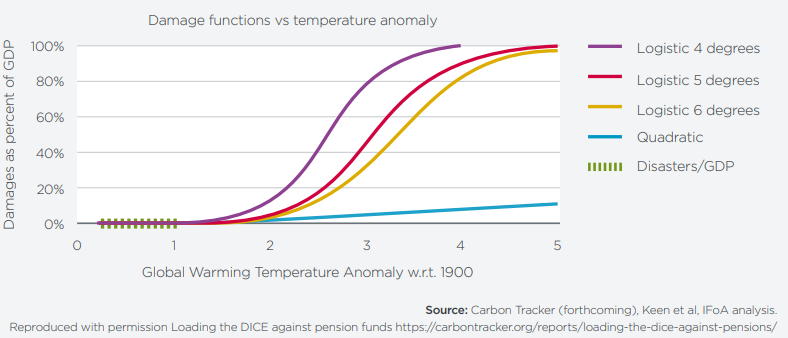
Unmitigated climate change could lead to a 50% drop in global GDP later this century. The higher the temperature anomaly, the closer we get to complete collapse.
A plausible scenario could cause a 15% to 20% global GDP contraction in just a five-year period—an economic shock far greater than the Great Depression or the 2008 Financial Crisis.
3. We Are Approaching Planetary Insolvency
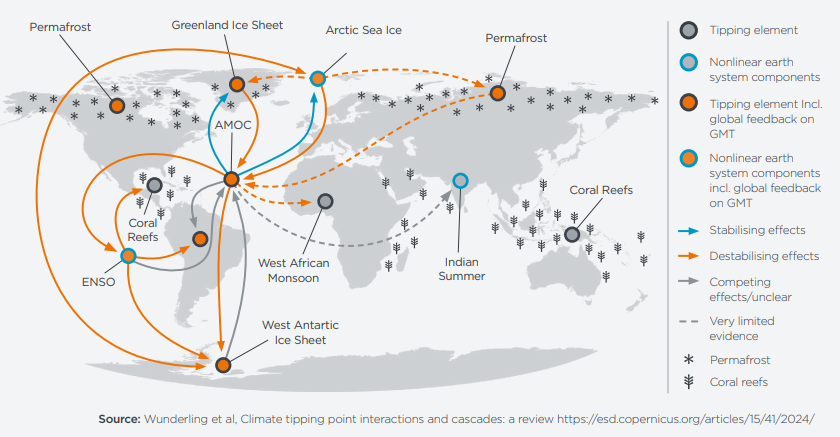
The report defines Planetary Insolvency as significant societal disruption driven by climate and nature risks. The decadal warming average is already at 1.4°C. At current rates, we are likely to hit 2°C mark before 2050. Once we pass 1.5°C, we enter the danger zone for irreversible tipping points, including the collapse of the West Antarctic ice sheet and the dieback of the Amazon rainforest.
4. The Earth is Absorbing Energy at an Insane Rate
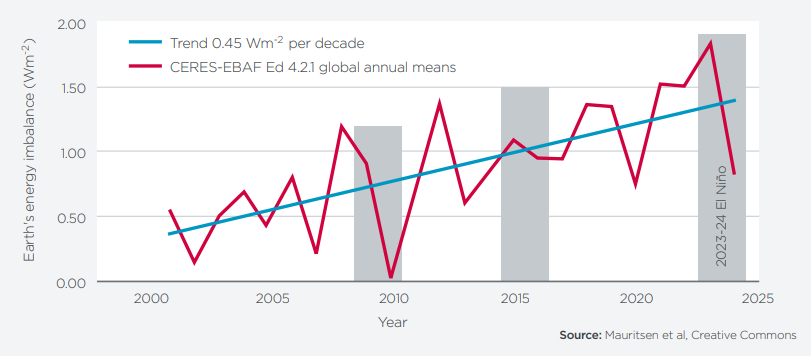
The Earth's Energy Imbalance (EEI) has doubled in recent decades. In early 2023, the rate of solar energy absorption was equivalent to every person alive on Earth continuously boiling 60 kettles. Since 1971, the Earth has accumulated 500 times more energy than the world’s total primary energy consumption in 2024. 93% of this heat is currently being stored in the oceans, a thermal debt that will eventually be paid.
5. The Human Cost: Mass Mortality and Migration
Beyond economic figures, the report warns of a severe humanitarian crisis. Unchecked climate change is expected to lead to mass mortality events and involuntary mass migration as populations are displaced by rising sea levels, heat stress, and the collapse of food and water systems. This is identified as a national security issue where the foundational stability of political systems is threatened by cascading failures in essential services.
6. The End of Insurability
Insurance is the invisible lubricant of the global economy. Without it, you can’t get a mortgage, start a business, or ship goods. Insured losses from natural catastrophes have nearly doubled in the last decade, from $77 billion in 2015 to $145 billion in 2024. These losses are currently doubling every 10 to 15 years. The report warns we are approaching a point where large swaths of the planet become simply uninsurable, leading to a total collapse of local economies. Insurance is the canary in the coalmine.
I won't waste your time adding in the usual "but here's what we can do" stuff that is obligatory for these kinds of reports. Still, it's worth the read.
Read the full report:
The site is free for all. No ads or corporate sponsors. Paid subscribers and one-time contributors help keep the site going. So do your kind words and comments. Thank you. Sarah.


