$80 Crude, $170 Reality
Why paper crude prices are lying to you

Desperate imperialistic attempts to unlock global energy reserves are a symptom of collapse. Unbeknownst to most, the world is scrambling to keep ahead of declining energy productivity (defined as Energy Return on Energy Invested [EROEI]).
If we had weaned ourselves off fossil fuels years ago we could have managed an orderly decline. Instead, chaotic executive decisions are creating massive instability, and energy bottlenecks will hurt the average citizen.
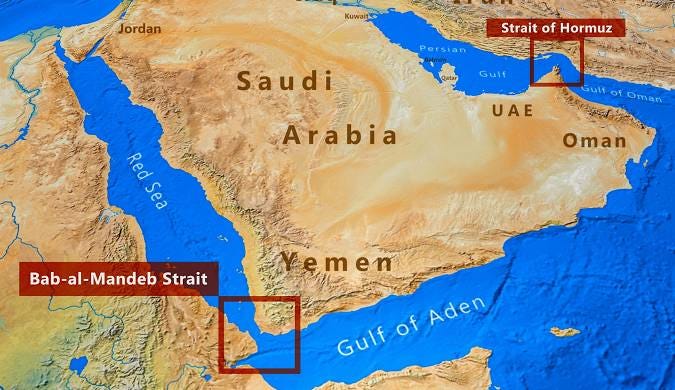
How is this the end of oil when oil remains around $80, despite the closed Strait of Hormuz and threatened Bab-el-Mandeb?
I'd suggest this is yet another step towards the deconstruction of US imperialism, given the amount of leverage bestowed upon the Islamic Revolutionary Guard Corps (IRGC). A 100 to 1 weaponry cost advantage layered deep within hidden storage sites buried across vast mountainous terrain and 47 years of preparation, plus on the fly learning has taught the IRGC, and others, that the mighty US war machine is defeat-able. Perhaps not in conventional terms, but in strategic terms. Clearly, the US hasn't learned from Vietnam, Iraq 2.0, and Afghanistan, and is precariously close to another 20-year quagmire. Only this time, 20+ percent of the world's energy market, and its more valuable derivatives, are at stake.
With America’s inventory of missiles severely depleted, incentives rise for IRGC to continue threatening the Strait of Hormuz. China has to be watching carefully as it weighs its options over Taiwan.
The petrodollar system, the foundation of American imperialism, is on notice, as America is no longer able to guarantee security for global shipping. America’s exorbitant privilege, its ability to run massive deficits, is contingent on global security guarantees. Some might call it a racket, but the US provides security and, in exchange, the rest of the world uses greenbacks for global trade. This creates a structural demand for dollars and US financial assets, underpinning American hegemony.
While the unwind of the petrodollar system won’t (isn’t?) happen(ing) overnight, the IRGC, hidden by terrain as big as California, only has to lob the occasional $40,000 drone to prove America can no longer hold its end of the bargain. US capital markets are deep and liquid so there remain reasons to hold US assets. However, diminished military projection is yet another cut among many (reckless fiscal deficits, broken alliances, gutted middle class, divided citizenry to name the obvious).
One cut might not kill, but a thousand? Devastating.
None of this is reflected by the crude oil price of roughly $80 at the time of writing. For a world sucking in the energy crack pipe, it is the refined products that matter. Diesel is arguable the most important product created from oil.
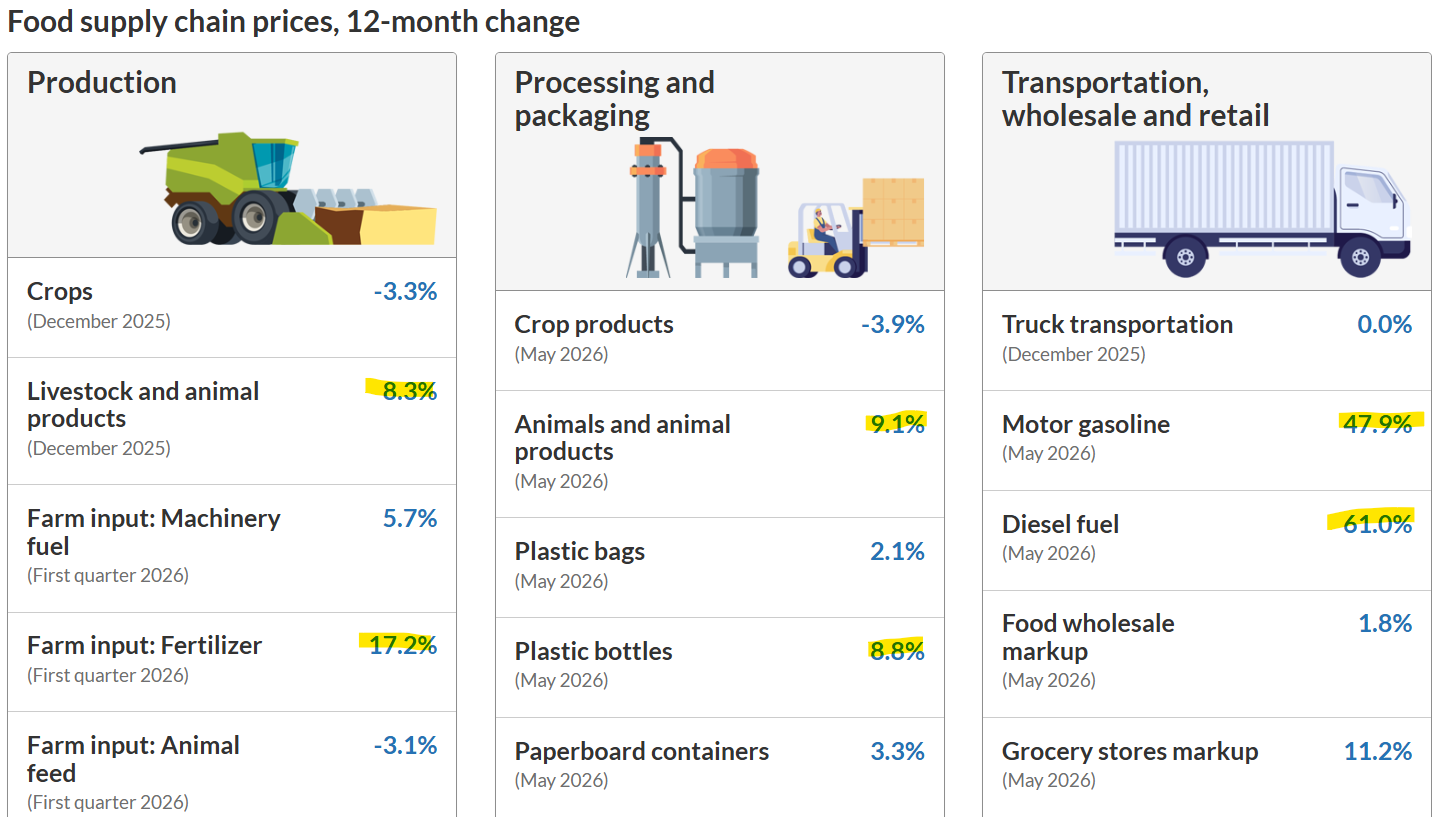
Diesel moves heavy freight trucks, farm equipment, cargo ships, construction equipment, mining machinery, and factories. Diesel ships your food to the grocery store.
Expensive diesel flows directly into consumer prices for food, consumer goods, housing, and travel. When diesel costs rise, transportation companies add fuel surcharges to every shipment. Farmers pay more to run tractors, and mines pay more to extract industrial metals. These increased expenses raise the Producer Price Index, which measures inflation at the wholesale level, before passing through into the Consumer Price Index at retail stores. Of course, this assumes there’s enough diesel to go around. Prices rise to throttle demand which outstrip supply, so presumably someone is going without. Today we’re starting to see higher prices. Tomorrow we may see export restrictions and hoarding.
Diesel is what matters and diesel prices have risen disproportionately relative to oil, telling a different story about how close we are to the edge. Current diesel prices imply a backwards equivalent price of oil between $140 and $170 per barrel.
The simplest way to explain the gap is the cost to refine crude oil into diesel has gone up.
Crude oil varies drastically by grade, and that difference dictates how much diesel we can actually produce. Light, thin crudes like US shale refine easily into gasoline, but yield relatively little diesel. Heavy, dense crudes require specialized, high-pressure equipment to break their thick molecules apart, producing up to half a barrel of diesel compared to less than a third from light oil.
When war or sanctions block heavy crude supplies, refineries must switch to lighter oil, causing global diesel production to plummet. When diesel supplies get tight, wholesale prices surge even if raw crude stays cheap. During recent spikes, wholesale diesel jumped above $4.60 a gallon, or nearly $194 a barrel. Subtracting normal processing costs (aka crack spread) reveals that while paper benchmarks show crude at $80, diesel buyers were actually paying prices that implied a real-world crude cost of $140 to $170 a barrel.
This is the economic reality, minus the panic. Can you imagine if newspapers printed $170+ oil on their headlines?
Not only is heavy and medium crude oil blocked from reaching refineries to be processed into diesel, the IRGC has attacked refineries across the Gulf.
Simultaneously, Ukrainian long-range drone strikes have targeted refineries inside Russia, knocking a significant portion of its refining capacity offline.
Prior to these strikes, Russia exported 1.0 million barrels per day of refined diesel to foreign markets. The destruction of Russian hydrocrackers cut off finished diesel exports, worsening the shortage of finished diesel.
All this has forced producers to shut-in production in a disorderly manner. A disorderly shut-in occurs when energy production or processing stops abruptly without preparation. This makes it extremely difficult to bring production back on line.
When a well sits idle without preparation, underground water rushes in to block the oil, and the crushing weight of the earth collapses the tiny microscopic cracks carrying the fuel. Thousands of feet below the surface, stagnant salty water and gases corrode steel pipes, while heavy waxes cool and harden to lock pumps in place. A sudden power loss at a refinery causes heavy crude to cool rapidly within miles of internal piping, turning into solid asphalt or carbon coke. Clearing a refinery after a cold shutdown requires workers to cut open equipment and blast out hardened sludge, while thermal shock can warp heavy pressure vessels and render multi-billion-dollar facilities permanent losses.
Bringing production back online after a disorderly shutdown is a slow, capital-intensive engineering effort taking months, years, or decades.
Apocalypse later
The world’s most important energy waterway is blocked. Houthi rebels are threatening another. Production is shut-in. Refineries are burning.
So why is the world not panicking?
The world is relying on stockpiles to fill the void. China especially, easing supply-demand pressure.
By late 2025, China accumulated 1.4 billion barrels of crude in combined storage by purchasing discounted crude from Russia, Iran, and Venezuela. This stock provided 110 to 140 days of net import cover, exceeding the US Strategic Petroleum Reserve stock of 413 million barrels and total US inventories of 824 million barrels.
After the Strait of Hormuz was closed, Chinese crude imports dropped 40% year-over-year in June 2026, falling to 6.2 million barrels per day. This eased pressure on crude oil demand, helping explain why prices for Brent or WTI didn’t skyrocket.
To supply domestic fuel needs without buying high-priced spot crude, Beijing directed state refiners to draw 41 million barrels from storage in June 2026 alone. Over a four-month period, East Asian reserves in China, Japan, and South Korea drew down 180 million barrels.
By withdrawing from spot market purchases, China absorbed some of the global supply deficit. However, Beijing imposed strict fuel export quotas, forcing domestic refiners to keep finished diesel inside the country. China’s inventory release lowered raw crude prices, but its export limits worsened global diesel shortages.
Inventories won’t last forever, and eventually there won’t be enough to mitigate the shortages. That’s when the world wakes up. Prices alone are painful, but when the barrels of crude are no longer available the economic system grinds to a halt.
For the better, one might argue. After all, aren’t we striving for a post-carbon world?
Unfortunately, chaotic unwinding of energy dependence is something we could have avoided with a little foresight. Instead we’ll be forced to quit heroin without the benefit of methadone.
War or no war, It was all to come anyway. Declining EROEI already had us headed towards an energy brick wall. Below a certain level, it simply becomes physically infeasible to extract oil from increasingly challenging sources.
Conventional oil fields discovered in the 1950s operated at EROEI ratios exceeding 100 to 1, delivering 99% of their extracted energy to society. Continuous depletion lowered the global average for conventional crude to between 11 to 1 and 18 to 1.
To offset declining conventional output, energy companies shifted capital toward unconventional sources, including US tight shale oil and Canadian oil sands. These sources operate at lower energy returns. US tight shale yields 10 to 1 to 15 to 1 at the wellhead, dropping to 6 to 1 to 9 to 1 at the point of use. Canadian bitumen yields 3 to 1 to 6 to 1 at the wellhead, leaving between 66% and 83% net energy for society.
Unfortunately, war is here. Probably unavoidable, as resource scarcity (disguised as a “fight for freedom”) is a big reason wars happen in the first place. So it was inevitable that lower EROEI, blocked supply, destroyed refineries would collide to form a direct tax across the physical supply chain, driving prices increases across food, vehicles, housing, infrastructure, anything wrapped in plastic, and more.
Within reason, higher prices are manageable. The real shock will arrive when shelves are bare because we simply lack the resources to produce and ship goods.