AI and financial implosion
Pick your poison
You'd be forgiven for thinking this post is for the "finance bros", I think it is relevant to those tracking the fuckery of the AI trade and the catastrophe that awaits.
I've come out swinging wildly that we could soon be staring an AI apocalypse in the face. Some of these models have proven to be cunning in a way we never expected and can't quite understand.
The recent Hugging Face attack is an example:
 Sarah Connor
I've also argued that the tech overlords are planning (hoping) to come out the other side of the poly-crisis intact, with an army of AI robots replacing the billions of dead humans. (That last sentence was wild to write, but that's where we are.) We are living in a science fiction novel. "Nah, they can't be thinking that", one might hope, but look at the damage they have done to society already. Most of us carry a mobile tracking and propaganda device 24/7. They don't allow their kids to use the technology they hawk to the unwashed masses.
So it's entirely plausible the bunker-building tech billionaires believe end times are approaching and that they have a way to gain from it while dining on wagyu beef.
 Sarah Connor
Being of analytical mind, however, I never think in absolutes. Rather, I think in probabilities. There are multiple futures and we're just along for the ride. Best to anticipate any eventuality. Including the one where the tech bros are crying "AI apocalypse" en masse while conspiring to insulate the AI capex build from financial reality.
There is an argument to be made that the companies leading the AI buildout realize their business model is a failure, in that it cannot generate a satisfactory return on investment. Yet, billions have been poured into debt to finance great imaginary ventures. Sure, the datacenters and GPUs are real, but the path to positive free cashflow is not. This is a pattern repeated throughout human history: railroads, canals, telecom, housing. All backed by real things that did something, but not enough of that something to justify the investment. All ended in tears.
Seeing this, AI execs, who have championed the biggest capex build in human history, fear reality is approaching.
It's no secret that these things aren't producing an ROI for anyone but the chip makers, so one can only imagine the questions when going - yet again - to institutional investors, hat in hand.
"What the fuck did you do with the last $10 billion I gave you?!?", they might ask, but likely in corporate speak.
Cautious funding means cautious capital expenditures. The only way to achieve that is a coordinated effort to sloooow the AI arms race, praying the business case can catch up. Of course, no respectful AI executive would admit this, fearing they'd tip the entire house of cards. Rather, a well-timed, coordinated comms plan led by internal "whistleblowers" and followed by AI leaders calling for a pause on development for the good of humanity spins the idea into a strength. Sounds like the plot of a movie, but it's nothing that a couple million dollars in "thank-you money" and a few phone calls couldn't achieve.
Much of this has been anecdotal until today.
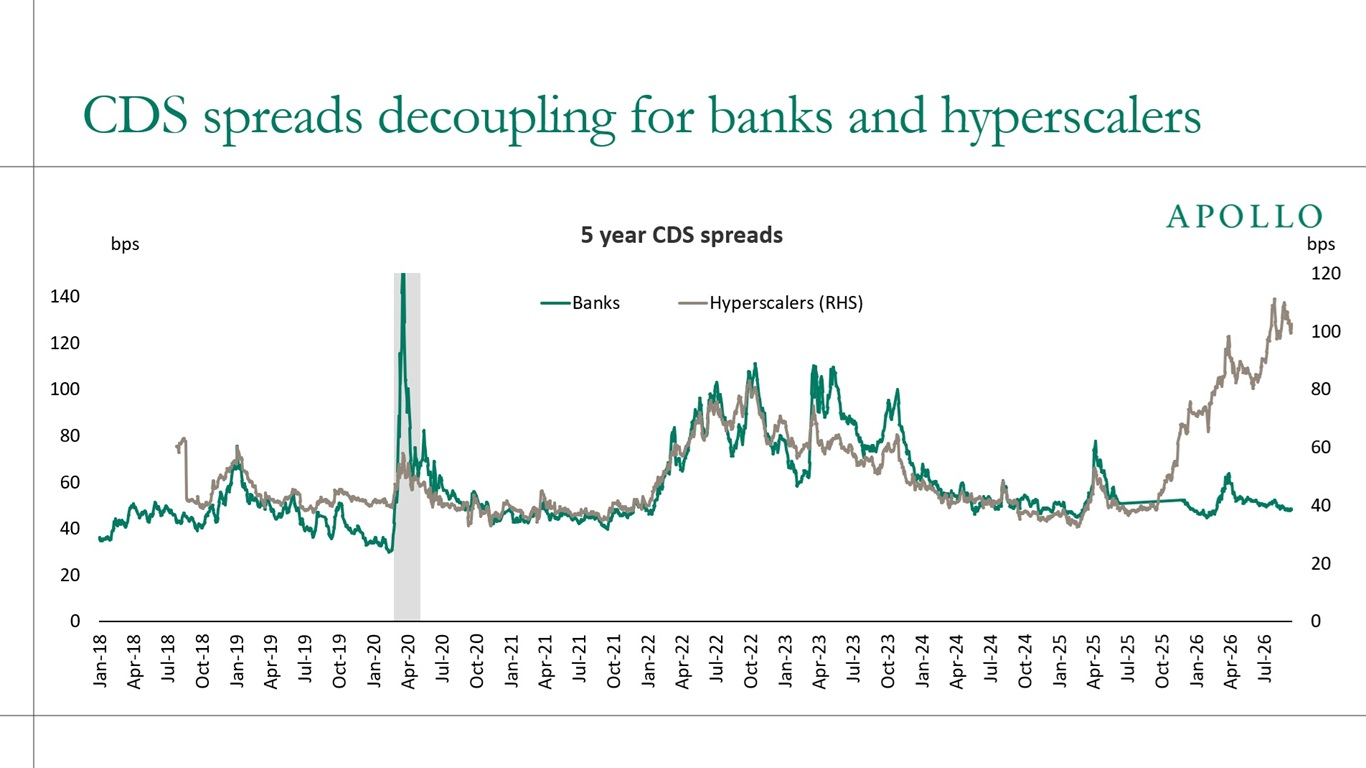
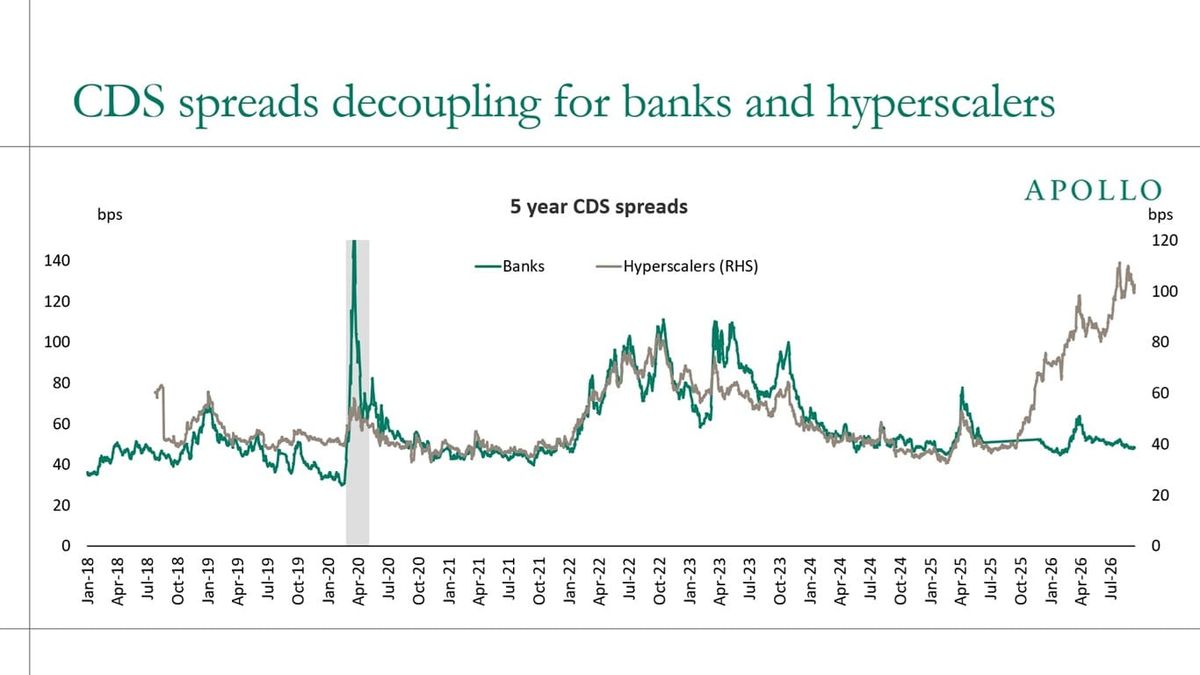
This chart shows the credit default swap spreads on Amazon, Google, Microsoft and Oracle. Rising spreads indicate an increasing cost to insure their debt against default. This doesn't suggest they will default, just that the probability has increased. The doubling in CDS spreads over the past year suggests lenders and insurers have rapidly become less confident in the narrative. And these hyperscalers were the companies supposedly able to pay for the buildout using existing free cashflow from other business lines. Not so much. These companies too have been tapping into the market for funding as free cashflow dives. "But their earnings are rising", one might hear. Reality: a significant portion of recent tech earnings is coming from the appreciation of investments in other tech companies. What the market giveth, the market taketh away.
If the massive tech companies are less creditworthy, how viable are the one-trick-ponies hiding behind circular revenue models?
I listen to folks like Ed Zitron and think, "he has a point". I listen to Jacob Coxon and also value his view. And then there are the Dan Ives of the world, who can also be quite convincing that we're heading to a utopian world of abundance.
Keep in mind that a) 80% of the time the market has historically been in a bull market, so the odds vastly in your favor if you have a positive outlook, and b) most financial commentators sell a product or service that requires a bullish view.
There are smart people on all sides arguing different things. But right now, it seems like, unless you ignore the real numbers, no matter what side you're arguing the outcome is catastrophic.
Either AI is rapidly advancing beyond our control and will someday accidentally shut down the internet, supply chains, infrastructure or electrical grid. Or it is a massive debt bubble with negative ROI that is about to implode, taking the global economy with it.
Pick your poison. Or perhaps you won't have to because both could be true at the same time.
Fun times ahead.
I am a one-person show and Collapse 2050 is a reader-supported publication. No ads, no corporate ties, no lobbyists. To support my work, become a paid subscriber or make a one-time contribution.
Thanks
Sarah


