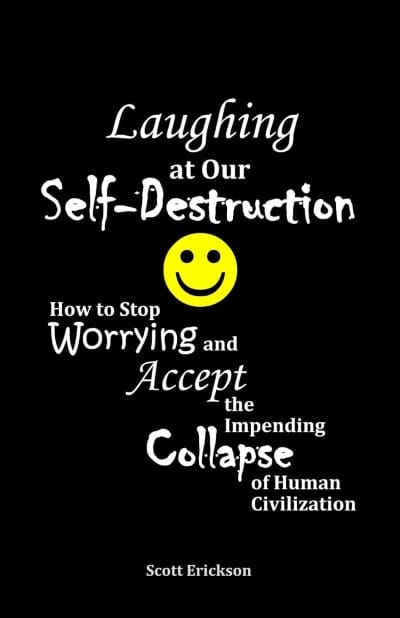
"Laughing at our self destruction"
Q&A with author Scott Erickson
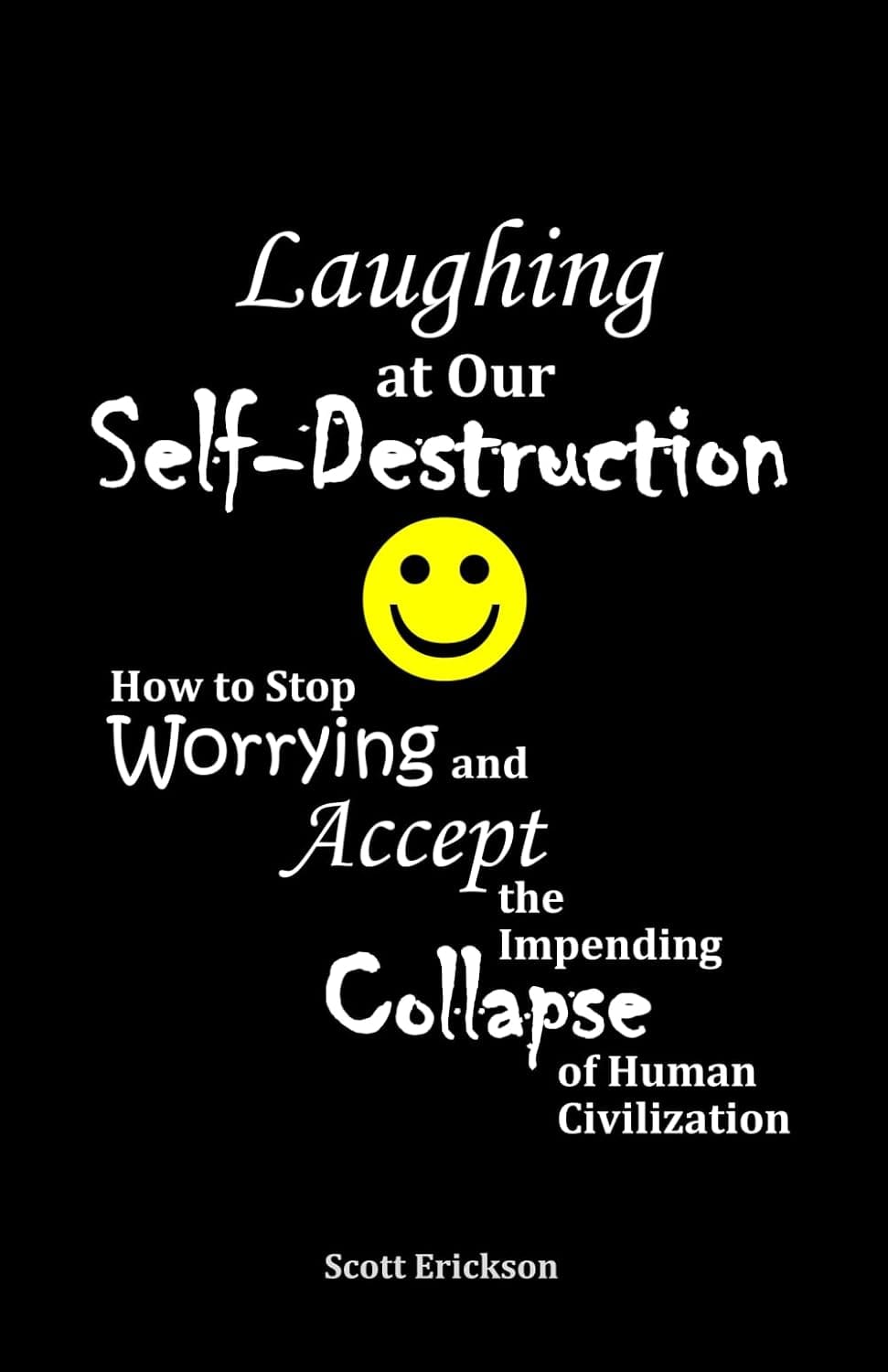
Scott Erickson is an award-winning writer of humour and satire. His latest book is entitled: LAUGHING AT OUR SELF-DESTRUCTION; How to Stop Worrying and Accept the Impending Collapse of Human Civilization.
It’s a book for people who suspect that humanity is doomed and are looking for confirmation that they’re not crazy. It offers a way to avoid despair and depression by showing readers how to stop worrying and laugh at our self-destruction.
I recently had the opportunity to ask Scott a few questions about his book:
Q: Given the improbable shift away from the "ego-based paradigm," is traditional activism anything more than a band-aid solution delaying inevitable collapse?
Erickson: It’s my opinion that collapse is imminent, whether a “hard collapse” of total social breakdown followed by the zombie apocalypse, or a “soft collapse” in which some vestiges of civilization survive. But even this outcome would be anything but “soft.” It would be catastrophic, and would involve a massive amount of death and destruction. I don’t advocate giving up on activism. But since I don’t see any activism that’s addressing the roots of our collective problems, my opinion is the best it can do is give us more time, and potentially lead to a less drastic collapse.
Q: If human extinction is the ultimate outcome, what is the deeper, life-affirming purpose of choosing humour and detachment beyond simple coping?
Erickson: The main goal of my book is to help people cope with our situation. Humour gives us the option of laughing at things that would otherwise make us curl up into a ball and refuse to eat. The subtitle of the book is a reference to Stanley Kubrick’s 1964 movie Dr. Strangelove. Or: How I Learned to Stop Worrying and Love the Bomb. The movie used a darkly comic approach to help people cope with the prospect of nuclear Armageddon. My book follows the same strategy of using humour to help people deal with the impending collapse of human civilization.
Q: Assuming the debt-based economy guarantees collapse, what is the most effective and safest way for an individual to fight this economic addiction locally?
Erickson: I’m not sure if it’s possible to fight our addiction to economic growth on the individual level. I suppose it’s possible to adapt to some degree by getting out of the financial economy as much as possible. But when the economy can no longer grow, that’s something none of us will be able to deal with – other than the billionaires who can fly to their fortified escape properties. The problem is that our addiction to economic growth is such a tremendous “elephant in the room” that it can’t be acknowledged. Just for fun, I’d like to see a member of Congress introduce legislation called “The End our Addiction to Economic Growth Act,” just to see what happens. I imagine politicians denying the problem, saying things like, “We’re not addicted to economic growth! It’s just that if the economy doesn’t grow it will collapse and take human civilization with it.”
Q: How do you reconcile your "philosophy of life based on life" and the choice not to have children with critics who view intentionally opting out of reproduction as selfish?
Erickson: Talk about a controversial subject! I find myself in the strange situation of not telling a lot of people I know about my book. Even some close friends. My book has many controversial views, such as the question of whether we should have children, and many of my friends have children. To me, the core of the problem is how we interpret the idea of “affirming life.” I’m looking at the bigger picture of our entire civilization, and asking, “Does our civilization affirm life?” The answer is “no.” We’re doing the opposite. We’re at war with life. So the question is: Does adding another passenger to the sinking ship affirm life? In my book I have an imaginary conversation with a parent that insists that the more babies we have, the bigger chance that one of them will grow up to solve all our problems. To which I ask, “Even the overpopulation problem?” To which the parent, of course, says, “Yes.”
Q: Given your view that American politics is a "broken bicycle" determined by the corporate-government complex, does voting for either major party contribute to the collapse rather than solve it?
Erickson: Another controversial subject! At least you didn’t ask me about religion! As for politics, I vote, but seldom with any enthusiasm. My view is that, as for the two major parties, the Democrats frustrate me and the Republicans scare me. And I guess I’d rather be frustrated than scared. Especially at this point in history, when a vote against the Republicans is a vote against fascism. Not that the Democrats are addressing the roots of our problems. But it’s not really their fault, since the public doesn’t want to address the roots of our problems. It would be great if there was widespread support for a new party called the Let’s Create a Civilization Aligned with Life Party. But I’m not holding my breath.
Special thanks to Scott Erickson for answering my questions. Please consider purchasing his book in December - perhaps as a gift for a fellow realist.