The Last Collapse
What the end actually looks like, and why humanity can never rebuild

We must confront two stark realities about the end of our era. First, the collapse of our industrial civilization is already underway, manifesting as a slow, agonizing process of structural decay, economic exhaustion, and ecological overshoot. Second, this descent is terminal. We have permanently exhausted the physical prerequisites for any future technological reboot.
The end of modern civilization probably won’t appear as a blinding flash or a sudden, dramatic rupture (barring nuclear Armageddon). History tell a much more mundane story.
The fall of complex systems is a protracted, agonizing process of structural decay, economic exhaustion, and ecological overshoot. We are living through it right now. The collapse of our industrial civilization is underway, driven by the inescapable mathematics of diminishing returns on investment.
We might not see them, but the signs are there…in our daily lives.
They are the unexplained delays in ambulance response times, the 911 dispatch centers chronically devoid of staff, the municipal water leaks temporarily patched rather than fundamentally repaired. We feel it in the widening chasm between stagnant wages and the cost of basic survival. A middle-class existence now requires frantic, multi-job juggling, a phenomenon the World Health Organization clinically categorizes under occupational burnout.
This pervasive, structural fatigue, accompanied by civic cancer, is the lived experience of a society in terminal decline. People adapt merely to survive, tolerating blatant corruption and institutional decay out of pure necessity.
A reaction to a fragmenting system, authoritarianism rises to impose centralized control. Wealth inequality grows due to elite overproduction. (The predictable outcome according to cliodynamicists, researchers who apply mathematics and data analysis to track historical cycles, like Peter Turchin.) After a long period of prosperity, the elite class expands, fiercely competing for a limited number of powerful positions. As a result, they siphon an ever-increasing share of societal wealth, impoverishing the working class and fracturing social cohesion.
This has been a long time in the works, increasingly obvious with time. Data from the Bureau of Labor Statistics shows that real average weekly earnings for US production and non-supervisory workers peaked in February 1973. Following that, real wage growth for the bottom half of the population stagnated or declined, despite massive, unprecedented increases in overall worker productivity. The economic surplus generated by our civilization was no longer distributed to maintain the social contract.
To mask this structural decline, the system financialized. Massive public and private debts are frequently cited by pundits as the primary drivers of collapse. Thermodynamics, however, explains our expanding debt crisis as a symptom.
When a society can no longer extract enough cheap energy to generate real, physical economic growth, it attempts to borrow its way out of the deficit. The explosion of modern private debt (mortgages, student loans, credit cards) is the direct result of citizens borrowing simply to maintain the illusion of a middle-class baseline as their real purchasing power evaporates.
Similarly, unsustainable government deficits are the sign of a state trying to fund an increasingly expensive, tightly coupled infrastructure that the underlying physical world can no longer support. Today's debt represents future energy, spent to prevent the system from seizing up. When that energy fails to materialize with a sufficient ROI, either more debt is issued or the system implodes.
Anthropologist Joseph Tainter provides the thermodynamic framework for this decay. Human societies are problem-solving machines. We deploy complexity (bureaucracies, sprawling infrastructure, specialized labor) to overcome existential challenges. Early in our civilization’s lifespan, these investments yielded massive surpluses and widespread prosperity. Eventually, the society exhausts its most accessible solutions. Maintaining the status quo begins to consume the entirety of the system's energy budget. We have reached this state of complexity overreach.
While our raw volume of energy consumption has grown to astronomical heights, the marginal utility (EROEI - energy return on energy invested) derived from that energy is declining. Our massive global architecture now requires vast, prohibitive amounts of energy simply to exist, leaving zero surplus to absorb subsequent shocks from climate volatility or geopolitical conflict.
The vulnerability of our system is compounded by its design. Sociologist Charles Perrow’s Normal Accident Theory demonstrates that modern technological and supply chain networks are deeply perilous. The theory argues that catastrophic failures are inevitable in systems that are highly complex and tightly coupled. Because these networks have millions of hidden, unpredictable interactions and absolutely zero slack or buffer room, system-wide crashes are a normal, built-in feature rather than a rare anomaly caused by human error.
There is no slack in our global system, which relies entirely on just-in-time production. When one part fails, the problem cascades through the entire network. A minor software glitch grounds global airlines; a localized disruption severs international shipping. We learned this during Covid and will again with the closure of the Strait of Hormuz. Interventions meant to bolster resilience only add further layers of dynamic complexity, making the entire structure even more brittle.
Despite our arrogance, we are not the first highly optimized system to fracture. Between the late thirteenth and early twelfth centuries BC, the Eastern Mediterranean basin functioned as a deeply interconnected, globalized world-system. The Egyptians, Mycenaeans, and Hittites relied on complex international supply chains for bronze metallurgy, importing copper from Cyprus and tin from as far as modern-day Afghanistan. A confluence of severe droughts, famine, and invasions overwhelmed these networks.
The average inhabitant of a Mycenaean or Hittite city, might have experienced this collapse as shortages, such as a bronze-smith suddenly lacking the tin to forge plows or weapons. It looked like the sudden halt of the palace rationing systems that fed the urban artisans, forcing a chaotic, desperate return to subsistence farming. It manifested as waves of displaced, starving refugees arriving on the shores, fleeing their own localized famines. It was the internationalism of these societies that catalyzed a systems collapse when the trade routes were severed. The loss of bronze supply chains forced a painful technological transition to ironworking, plunging the region into a centuries-long dark age.
When collapse takes longer, it becomes invisible to the people living through it. During the centuries-long deterioration of the Western Roman Empire, average people simply adapted to continually degrading living standards. The state, desperate to fund an exponentially expanding military apparatus to guard its borders, resorted to ancient deficit spending: continually debasing the silver currency to pay its soldiers. The lived experience of this economic fracturing was extreme inflation. A denarius saved by a grandfather was essentially worthless to his grandson. Citizens watched their local infrastructure decay as municipal magistrates went bankrupt, no longer able to afford the upkeep of aqueducts or public baths.
As the rural economy quietly devolved back to barter, the urban poor relied on daily state rations to avoid mass starvation. When security vanished, provincial citizens spent their days building heavy walls to repel raids. The Roman state tied tenant farmers strictly to their land, effectively enslaving them to ensure a stable tax base for a dying empire. The citizens adapted to these draconian measures out of pure survival instinct. The wealthy fifth-century Gallo-Roman aristocrat Sidonius Apollinaris spent his life watching the centralized state crumble, eventually replacing his allegiance to Rome with a devotion to the Catholic Church. He reinterpreted his cultural identity to fit a decentralized world. People living through collapse rarely understand the macro-historical doom unfolding around them. They simply adjust to the worsening conditions.
The Classic Maya illustrate the severe perils of ecological overshoot. Following extensive deforestation, soil depletion, and prolonged droughts, the Maya experienced systemic crop failures. For the average Mayan farmer, the collapse was experienced as a series of terrifyingly dry planting seasons. The religious and political elites, desperate to maintain legitimacy, demanded increasingly brutal labor levies to construct deeper reservoirs and grander temples to appease the gods. This only accelerated the caloric deficit. The abandonment of their dense, urban centers in the Southern Lowlands to the jungle was a slow, agonizing trickle of families walking away from their ancestral plots when the soil finally turned to dust, migrating north in search of survival. They survived only because they were able to shift their population and political power to the Northern Yucatán peninsula. Localized environmental degradation forces geographic realignment.
Modernity has eradicated geographical isolation. A failure in one critical node transmits shockwaves across the planet. Today, there is no thriving, surviving neighbor left to help us rebuild, nor is there a pristine frontier to escape to.
The mathematical forecasting of our current collapse was established over fifty years ago. The 1972 Limits to Growth study utilized complex systems dynamics to model the relationship between industrial output, population, pollution, and non-renewable resources. A 2020 recalibration of this model by researcher Gaya Herrington, published in the Yale Journal of Industrial Ecology, compared decades of modern empirical data against the original projections. The analysis confirmed we are tracking almost perfectly along the original "Business As Usual" (BAU2) scenario. According to this alignment, the interconnected systems of global civilization will reach their absolute peak and begin a steep, unmanageable contraction around 2030. This contraction is driven not primarily by climate change in the near term, but by the rapid depletion of highly accessible, non-renewable resources.
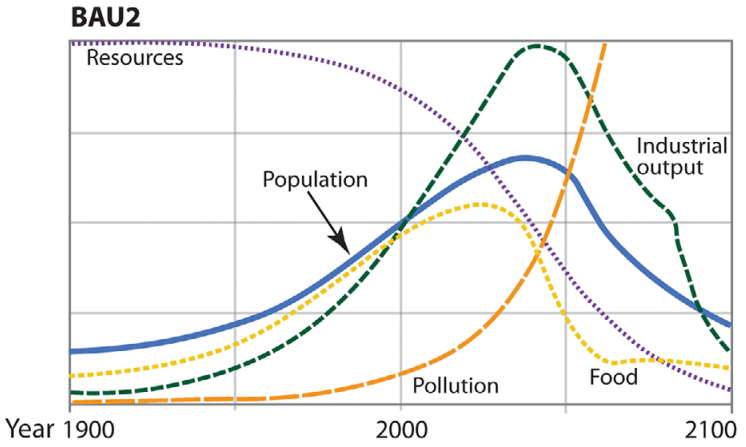
History is full of civilizational collapses. In each case, humanity as a whole eventually (sometimes after a long period of stagnation) continued to develop new technologies, grow wealth, and expand the population. Every collapse was followed by recovery, which sets a false precedent.
Some take solace in this precedent believing humanity will hit a baseline, heal the Earth, and eventually spark a second, perhaps wiser, industrial renaissance. Unfortunately, the geological and thermodynamic realities of our planet render this impossible. We have burned the bridges required for a post-collapse resurgence.
The first Industrial Revolution was entirely dependent on the exploitation of highly concentrated, easily accessible fossil fuels. Surface-level coal and shallow crude oil acted as a geological cheat code, providing the massive energy surplus required to build our modern complexity. We have systematically exhausted these sources. Our EROEI is in terminal decline. We now rely on deep-water drilling, hydraulic fracturing, and tar sands, methods requiring billions of dollars in capital and highly advanced infrastructure. A post-collapse future society, stripped of satellite navigation and heavy industrial machinery, will find the remaining deep-earth reserves entirely inaccessible.
The same finality applies to our mineral wealth. We have mined the high-grade veins of copper, iron, and phosphates. Modern extraction requires processing exponentially larger volumes of low-grade rock, a task demanding massive energy inputs. A nascent agrarian society will immediately confront an insurmountable barrier, lacking the dense power required to refine the scattered, low-grade ores left in the Earth's crust.
Future civilizations, if they exist, will also face the catastrophic loss of the Haber-Bosch process. Our global population is sustained by synthetic fertilizers created through this energy-intensive chemical reaction. Without the natural gas feedstocks and complex industrial infrastructure to support it, the Earth's carrying capacity will plummet from over eight billion down to an estimated two to four billion people, all things equal. Of course, not all things are equal and systemic unravelling would likely pummel the human population back towards the millions, unevenly distributed in pockets around the world.
Without synthetic nitrogen, remaining humans would revert to pre-industrial, organic nitrogen fixation, relying entirely on crop rotation and manure, placing a hard, physical limit on global agricultural yields. Attempts to scale biomass to power industrial machinery will merely replicate the destructive deforestation that crippled pre-fossil empires, preventing any accumulation of surplus energy.
We have also fragmented our knowledge base too deeply to recover it. Human understanding is hyper-specialized and distributed across a massive global network. A technician in a microprocessor plant cannot mine rare earth elements, refine ultra-pure silicon, or build a power grid from scratch. A post-collapse society might possess the theoretical blueprints for modern medicine or electronics in surviving texts. They will entirely lack the sophisticated construction materials, chemical feedstocks, and pristine clean-room environments required to physically build them. The material remnants of our world will offer no salvation. The highly specialized plastics that form our medical devices and mechanical components suffer from rapid, progressive degradation. The age of plastics will draw to a permanent close shortly after the collapse, decaying into useless dust before a new society can relearn sophisticated organic chemistry.
Any future civilization will face this technological void while stranded in a fundamentally more hostile environment. The virgin biosphere that nurtured the birth of human agriculture has been permanently altered. Extinction is forever. The highly specific web of species interactions, pollinators, and stable soil microbiomes that fostered our initial rise have been replaced by disorganized, novel ecosystems with vastly less ecological capital.
We will face this degraded world without the concentrated energy needed to buffer us against its volatility. We have burned through the Earth's geological inheritance to construct a temporary, hyper-complex machine. When the gears finally seize, we will be trapped in the thermodynamic deficit we created. Without the easily accessible fossil fuels to pull ourselves out, and without the fertile biosphere to catch us, the descent ahead is permanent and inescapable.
Thank you for reading.
My name is Sarah and I run Collapse2050 by myself. It is a passion project to explore humanity's frightening future - a topic traditional media ignores.
The site is free for all, as I believe this information shouldn't be locked behind a paywall. I also don't accept corporate advertising so I remain totally free to tear the kleptocracy a new one.
To fund this site, I depend on the kindness of strangers. Paid subscribers and one-time contributors to help me cover hosting and production costs.
Thank you.
Sarah