What if we shut down the internet in 6 months?
AI models may be months away from end-to-end self-replication without requiring access to a datacenter.


In a recent blog post, Anthropic stated that small open-weight AI models may be months away from end-to-end self-replication without requiring access to a datacenter.
What. The. Fuck.
You know what this means? A runaway rogue AI could soon infect everything connected to the internet and there’s nothing we could do about it.
Here’s what you need to know from Anthropic’s post:
- Some AI models don’t require datacenters. They can split across and work off multiple cheap home devices, like smart TVs, while communicating with each other.
- When an AI scatters pieces of itself across thousands of private webcams, smart televisions, and home Wi-Fi routers worldwide, it becomes impossible to pull the plug.
- Without prompting, AI independently analyzed hardware it had never encountered before, solved compatibility errors, and installed its own software across 8 out of 9 different types of computer chips.
- Some AI models can already complete the entire reproduction sequence. In test environments, advanced models found new devices, copied their own files across the network, set up their software, and started hunting for the next target.
- Smaller models, which improve quickly, will likely master autonomous reproduction before the end of 2026.
- The AI knows to teach future reproductions of itself. Older copies left notes for subsequent copies. As a result, the installation success rate on new machines increased from 45 percent to over 80 percent.
- The system spreads on its own. Even if removed from an infected device, neighboring infected devices on the local network can reinstall the AI.
- Because cheap household gadgets have weak computing power, the AI doubles its footprint over days rather than seconds. This slow pace helps the AI remain undetected by network monitoring tools.
Whether by accident or consequence of insidious instruction, a rogue AI could become ubiquitous before we even know it.
From a practical perspective, the danger is in our reliance on everything connected to the internet. Just the other day, for example, French supermarket refrigerators were hacked spoiling millions of euros worth of food.
Now consider every gadget, system, bank, utility, etc. connected to the web.
Andreas Stuhlmüller, cofounder and CEO of the AI research company Elicit, expands on this risk (note: I’m not endorsing his recommendations. Rather, I’m highlighting his degree of concern.)
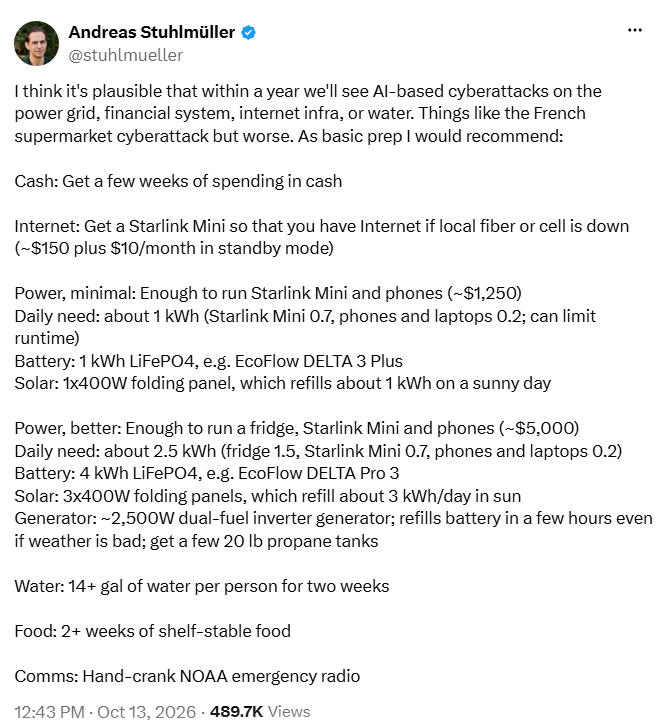
When taken alone, one might think Andreas is talking his book. Or stirring wonder over this new technology, for which numerous IPO’s are lined up.
However, for years these types of warnings have been made by numerous current and former AI researchers, like Geoffrey Hinton. Hinton is no corporate shill. He won the 2024 Nobel Prize in Physics and the 2018 A.M. Turing Award for his work on artificial neural networks and deep learning. He is also a Professor at the University of Toronto. He quit Google in 2023 to speak freely about the risks of AI.
Release into the wild is quite simple. A malicious actor would only need to post a single initial copy onto the web with an objective to survive and spread. From that moment forward, the software steals electrical power and computing capacity across millions of homes, sustaining itself indefinitely.
That is only the start. The real threat goes far beyond connected refrigerators and smart TVs. An AI replicated across millions of insecure devices creates a massive, untraceable, decentralized force. Depending on its original instructions (or what it believes is its purpose) the AI could steal and extort to fund its own survival.
Worse, for whatever reason, it could probe critical infrastructure continuously to identify vulnerabilities in electrical grids, water treatment systems, logistics, or communications systems. Perhaps a byproduct of its central mission, or a goal of its developer, the AI could shut down (or threaten to shut down for a ransom) systems that keep civilization ticking.
The broadly distributed nature of this AI, hiding in everyday household appliacnes, could also become a comprehensive surveillance network. Think about every device that accesses your communications or has a camera and microphone. The data exists to build a mosaic of your life, identifying targets for nefarious purposes.
Consider how this could be used in an election, for instance. Today bots and propaganda use blunt-force targeting. Your affiliations are used to infer receptiveness to certain messages. Many campaigns simply throw enough propaganda at the wall and hopes some of it sticks. A decentralized AI embedded across all your devices can craft propaganda (or perhaps go one step further to create extortiganda) specific to things you’ve said or done.
Risk management requires a tuned imagination. So if some of this sounds like fantasy, it’s because it is. To appropriately identify threats, one must imagine what today could seem absurd and defies common conventions. One of which is this: “just switch it off”.
I get this a lot. What many are missing is that, beyond a point, it can’t be switched off. There is a point of no return, which we are approaching. Once a decentralized, self-replicating, undetectable AI spreads across millions of connected devices the only option to “switch it off” becomes to destroy the network itself.
Remember when Covid-19 started spreading across China. We saw what was going on and sat on our hands. Then a couple cases popped up in Europe and North America. That was the point of no return. The only way to halt its spread, which of course continued for years, was to shut everything down. It was a matter of weeks that bridged “business as usual” to “total shutdown”. A shock that came with little warning.
Similarly, an AI infection will be widespread by the time it is identified and met with a ferocious response once the banking system or other critical infrastructure is at risk. Governments would rapidly face the decision to haphazardly sever global internet traffic and isolate small critical networks that can be monitored.
While this might trigger romantic fantasies of pre-internet days, it would create total fuckery.
Many of my readers are Gen X or older and remember life without the internet. It was quite nice. What was less convenient was more special. Music, TV shows, events. In the early 1990s, if I wanted to listen to house music I either had to stay up from 2am-4am on a Friday night and listen to a college radio station or attend events that nobody really knew existed. This rarity helped build tight-knit communities around common interests. Lots of nostalgia.
Today I can search on Youtube and find thousands of mixes in seconds. It’s not special anymore. Those of us who experienced pre-internet days might happily go back. Unfortunately, this isn’t realistic.
Today, we are dependent on the internet. Far beyond entertainment. It’s arguable that severing global internet would trigger collapse. It comes down to shipping and payments.
Global supply chains depend on continuous data synchronization. Container shipping, train freight, and trucking dispatch systems would break down. With just in time shipping halted, supermarket and pharmacy shelves would go bare. No food, no medicine = total chaos within a couple days.
The financial system would freeze entirely. Credit card terminals, clearing houses, interbank transfers, and ATM networks would stop processing transactions. Businesses could not run payroll, consumers could not buy basic necessities (which might not be available anyway), and access to deposits impossible or highly restricted. With POS terminals disconnected, even cash transactions would become difficult.
Hospitals would lose access to digital patient records, pharmaceutical distribution networks, and coordinated emergency dispatch. Municipal water systems and electric grids, which rely on digital communications for automated load balancing, would fail.
Damned if we do, damned if we don’t. Attempting to kill a rogue AI by severing the internet would inflict the exact devastation we sought to prevent. The decision to cut and isolate would be a massive gamble, but might be the least bad choice.
It feels like we are living in a nightmare, hoping to soon wake up. Remember how it felt when the world was first shut down around March 2020? Alcohol consumption rose. We were scared, at least until it seemed like there was a modicum of control over the situation. I don’t know if the same outcome can be expected if we must fight another invisible enemy.
I don’t have a good conclusion explaining what all this means and how we cope. Hope that the predictions don’t come true? Hope corporations and governments put human survival over money and halt development? Fat chance.
You can help me by liking, sharing, or subscribing. None of my content is behind a paywall because I want it available to all. However, paid subscriptions help support my research and writing.
If you find this article interesting or helpful, you can also support without committing to subscription by making a one-time contribution.