Collapse of US Agriculture
Potential disaster in 2026

The American Southwest has entered a state of terminal hydrological collapse. The mountain snowpack that sustains the region has failed pushing American agriculture toward a potential disaster in 2026.
This high-altitude frozen reservoir is currently at its lowest level in recorded history, signaling an immediate crisis for the 40 million people and the vast industrial complex dependent on the Colorado River. This is a structural shift in the region's ability to support human life and economic activity.
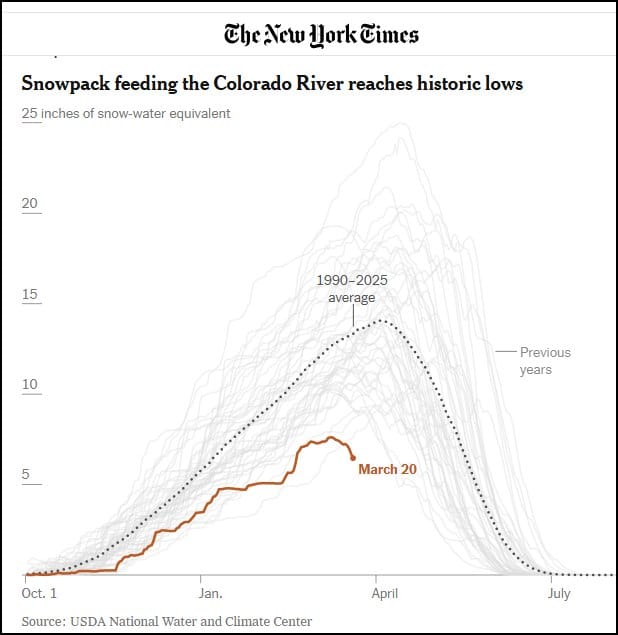
Across the Upper Colorado River Basin, the snow-water equivalent is at 61 percent of the historical median. This is the most severe snow drought since the launch of the MODIS satellite tracking system in 2001 (NASA Earth Observatory, 2026). Other critical headwater regions are worse: the Colorado River headwaters report 54 percent of the median, and the Four Corners region has plummeted to 47 percent (SNOTEL/NRCS Current Basin Snowpack Report, March 2026).
During the winter of 2025-2026, record-high temperatures shifted precipitation to rain at elevations below 8,000 feet. According to the NOAA National Centers for Environmental Information, December 2025 was the warmest on record for the Intermountain West. This heating precludes the accumulation of the snowpack reservoir. Instead, the rain runs off during the winter months, leaving the natural storage system empty ahead of the critical summer demand season.
An extreme heatwave in early March 2026 forced the record-low snowpack to peak weeks ahead of schedule. This early melt allows evaporation and parched soils to claim the majority of the water before it reaches the fluvial network.
As a result, Federal forecasters project that cumulative inflows into Lake Powell for the upcoming summer will fall to 36 percent of the historical average (Colorado Basin River Forecast Center, 2026). This failure ensures that the natural drip irrigation system will cease functioning, leaving downstream communities without a reliable water source during the hottest months of the year.
The Colorado River is of vital importance to the American Southwest. Its failure threatens the survival of major urban centers and the stability of the regional economy. 40 million people rely on this single river system for drinking water. The Colorado River supplies one-third of all water for Southern California via the Colorado River Aqueduct.
In Arizona, the Central Arizona Project canal delivers water to 80 percent of the state’s population. Las Vegas draws 90 percent of its supply from Lake Mead. No viable alternatives exist for this volume of water. As river levels fall, millions face the physical reality of a dry tap.
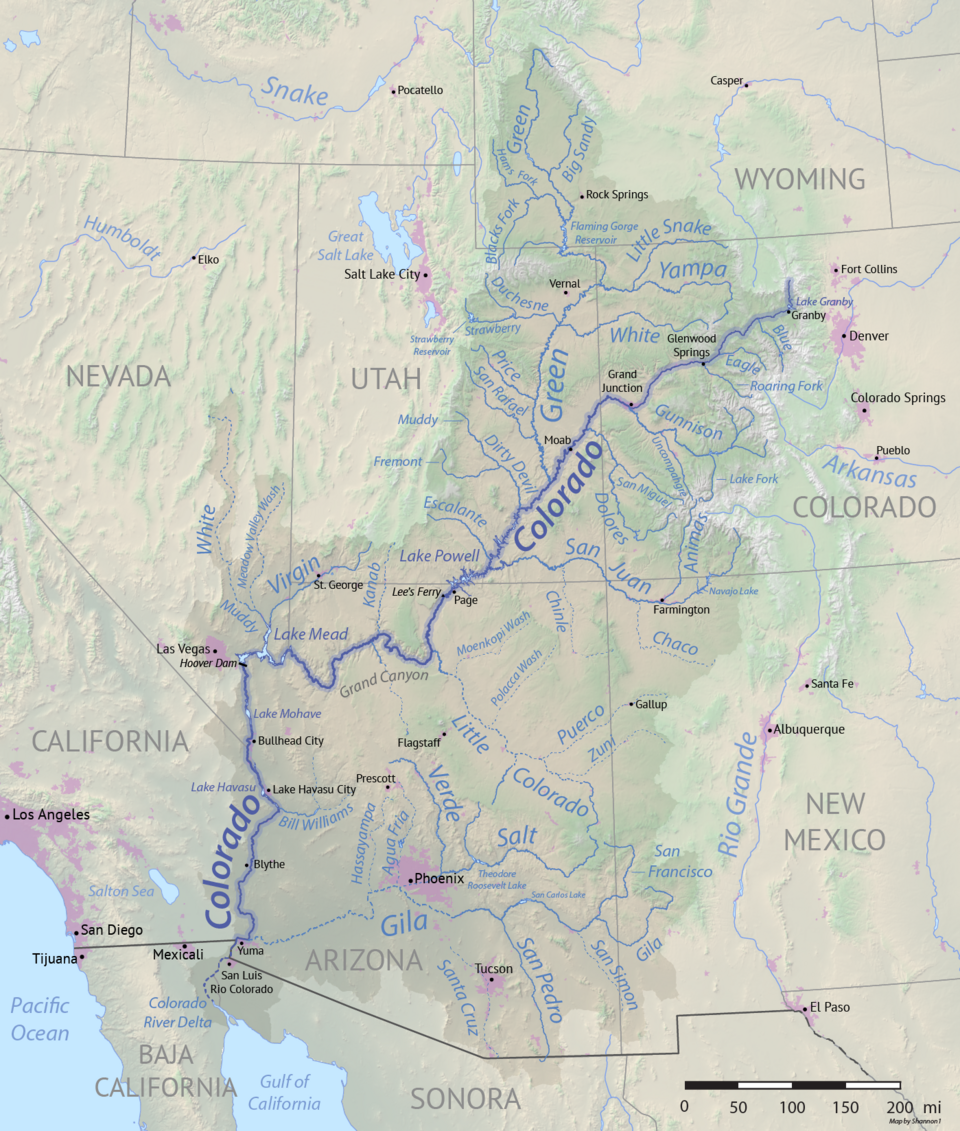
The river also supports $1.4 trillion in annual economic activity and 16 million jobs. This includes the Glen Canyon Dam and Hoover Dam, which are vital hydroelectric facilities.
The Bureau of Reclamation projects that Lake Powell will breach its minimum power pool of 3,490 feet by early 2026. At that point, hydroelectric generation for 4.5 million people stops entirely. Should levels reach the dead pool elevation of 3,370 feet, water will become physically stagnant. It will fail to pass through the dam to the Lower Basin, effectively severing the water supply for Arizona, California, and Mexico. The loss of this power forces utilities to buy replacement energy at rates up to $1,000 per megawatt-hour, a 3,200% increase (Western Area Power Administration, 2026).
Alternative water sources are either physically incapable of replacing the river or economically prohibitive. Accelerated groundwater pumping is a non-renewable strategy. Over-pumping collapses underground geological structures, resulting in irreversible land subsidence.
Once these groundwater sources collapse, the aquifer permanently loses its storage capacity. In coastal regions, this over-extraction draws seawater inland, poisoning municipal and agricultural wells.
Desalination, another alternative, is limited by energy requirements and toxic waste streams. Reverse osmosis depends on a stable energy market. With the 2026 disruptions in the Middle East, the operating costs for desalination have skyrocketed, making the water expensive for agriculture and municipal users.
The communities of the Southwest are critically tethered to the Colorado River. No viable substitute exists.
Agriculture and the Food Supply
Agriculture consumes 80 percent of diverted Colorado River water. The current deficit forces an immediate restructuring of the U.S. food supply.
The Colorado River Basin states of Arizona, California, Colorado, Nevada, New Mexico, Utah, and Wyoming dedicate 54 percent of all basin irrigation water to forage crops for livestock. Alfalfa alone consumes enough water to satisfy the indoor residential requirements of all 40 million basin inhabitants for three and a half years.
As water supply is cut, the cattle and dairy industries face liquidation. This creates a temporary glut of beef followed by permanent supply contraction and severe price inflation.
The Lower Basin also produces 90 percent of all winter vegetables consumed in the United States. While these high-value crops are more water-efficient, they are vulnerable to the same hydrological collapse. Water rationing in the Imperial Valley and Yuma County directly removes vegetables from the national market, making fresh produce a luxury item for the American consumer.
The Strait of Hormuz
This regional water crisis collides with a global energy and fertilizer shock. Following Operation Epic Fury, Iran effectively closed the Strait of Hormuz, trapping 20 percent of the world's oil, LNG, and approximately one-third of the world’s seaborne fertilizer. The loss of natural gas impacts fertilizer production globally. The loss of 50 percent of the world's seaborne sulfur hurts phosphate fertilizer production.
This disruption occurred exactly as Northern Hemisphere farmers commenced spring planting, creating a global shortage of the chemical inputs required to sustain crop yields.
The simultaneous failure of the Colorado River and the fertilizer supply chain leaves American agriculture in peril this year. Compounding water and fertilizer shortages with high energy prices, American agriculture is getting pummeled by physical and financial shocks.
This convergence exposes the fragility of a hyper-connected agricultural system, which is totally dependent on energy, chemical inputs and dwindling water supplies. The record-low snowpack is a symptom of permanent aridification and a changing climate. Efficiency and conservation are no longer sufficient responses to a system that has fundamentally broken.
The Colorado River can no longer support a water-intensive livestock industry. To get through 2026, in my opnion, the region must now prioritize crops for human consumption over animal feed.
The American food system is quietly edging towards catastrophe.
Thank you for reading.
My name is Sarah and I run Collapse2050 by myself. It is a passion project to explore humanity's frightening future - a topic traditional media ignores.
The site is free for all, as I believe this information shouldn't be locked behind a paywall. I also don't accept corporate advertising so I remain totally free to tear the kleptocracy a new one.
To fund this site, I depend on the kindness of strangers. Paid subscribers and one-time contributors to help me cover hosting and production costs.
Thank you.
Sarah


