Functional longevity in preparation for collapse
The core pillars of strength, balance, and mobility to remain an asset to your household and community

As we look over the horizon towards civilizational breakdown, preparation often centers around supply chains, food storage, water collection, and community building. Too frequently we overlook our most important asset: our own bodies.
All the gear in the world won’t save you if you lack the physical capability to use it.
Especially as we age.
Right now, a functioning industrial society subsidizes physical decline. If your body breaks down, modern systems provide cars, labor-saving gadgets, medications, and orthopedic surgeries to help. But as resources tighten and economic systems contract, assistance becomes either too expensive or completely unavailable.
Betting your future on an institutional safety net (that has already weakened over the years) to carry you through physical frailty is a massive gamble. Real resilience has to be built from the inside out.
After age thirty, our muscle mass, bone density, and coordination naturally start to deteriorate. This process accelerates in middle age, and, if nothing is done to fight it, leaves us vulnerable to falls and broken bones. Muscle is protective, which is why, after years of muscle deterioration, falls are so dangerous for the elderly.
Combined with modern sedentary habits, most people end up losing their physical independence long before the end of their lives. The idea isn't to live longer. Rather, it is to live better for longer. Some people refer to this as "health span".
In an eroding civilization, a lack of physical capability shifts you from an asset to a liability for your household. Food production is hard work. Hauling water, moving compost, turning soil, and clearing brush require real strength. If a sudden back tweak or an old injury leaves you stuck on the couch, you end up consuming resources without contributing to the survival baseline of your group. Staying strong means you stay useful, healthy, and independent for a much larger chunk of your life.
Now is the time to start building physical strength and resilience. It doesn't need to be difficult.
A big mistake people make is treating fitness like an emergency project. They smash themselves with sporadic, intense workouts. For a middle-aged beginner or intermediate person, this usually just leads to injury, system-wide inflammation, and quitting the routine entirely. Have you ever seen a gym on January 2nd? It's packed with new well-meaning members. However, by February only those who have turned fitness into a repeatable habit remain.
Fitness is a daily maintenance habit. Consistency beats intensity every single time, and is what nurtures the habit. Small, manageable movements done day in and day out build deep structural integrity over months and years, giving you a physical buffer that survives macro-level chaos.
The key to building this habit is NOT to wait for motivation or to be ready. It is the action itself that builds the motivation over time. Motivation must be manufactured. Accomplishing a goal, such as a workout, creates an addictive hit of chemicals in your brain. Do that enough times, and you start to crave the rush you get from exercising.
Still, even for the seasoned fitness pro, motivation comes and goes. The key is just showing up to build and maintain a pattern.
I'm reminded of a quote by actor, artist, and former NFL player, Terry Crews.
"I tell people this a lot - go to the gym, and just sit there, and read a magazine, and then go home. And do this every day. Go to the gym, don't even work out. Just GO. Because the habit of going to the gym is more important than the work out." – Terry Crews
Now, this quote isn't literal. The point of going to the gym isn't to read the paper. Rather, Crews' idea helps to reinforce the act of going to an environment in which exercise takes place. Once there, layering on the actual exercise is the easy part.
There's always a "good" reason to put it off. The to-do list is infinite. But as someone who's experienced a life-threatening event I realize the only person that can prioritize your health is you! None of those other things matter if you are physically incapacitated. So rain or shine, I commit to exercising five days a week. On days I feel like putting it off, I just show up and plan for a 15 minute workout.
Of course, exercise should go beyond the gym. A one-hour workout can't counterbalance twelve hours of sitting on your ass. Building physical resilience is part focused intensity and part lifestyle.
You don't need to train like a bodybuilder or a competitive powerlifter if you seek functional utility. I focus my training on three core pillars: leg strength, mobility, and balance. This helps me walk uneven ground, carry heavy loads, and avoid bad falls.
I don't exercise like the "gym bros" using barbells to do squats and deadlifts. While these hard-core exercises can be beneficial when done properly, most people don't know how to do them properly. It really requires professional guidance. The risk of injury simply isn't worth it, especially since there are alternatives. This is especially important for middle-aged skeletons, which usually have some wear and tear. Heavy spinal compression via heavy barbell squats risk exacerbating sciatica and other back issues. Instead, the aim of strength exercises is to create high mechanical tension on the muscles while protecting the spine from axial loading.
It is important to put injury prevention first when exercising. Exercise-specific warmups (starting at light weights), mobility exercises (e.g. dead hangs, external rotations with bands), and balanced muscle strength will help prevent injury. Gradually increasing intensity over time (rather than pushing too far beyond your limits) is important, as tendons can take time to catch up to muscle strength. It is also important not to hold your breath while lifting weights, as this can cause blood pressure spikes.
The final part of the fitness puzzle is recovery. I sleep 8 hours a night, don't work the same muscle group two days in a row, split my 5 days with a lighter workout in the middle, and eat a varied nutritious diet.
Below I have listed some exercises I do to build leg strength, mobility, and balance. I also do other exercises, but what I've listed below can be the starting-point of a beginner-to-intermediate level exercise program.
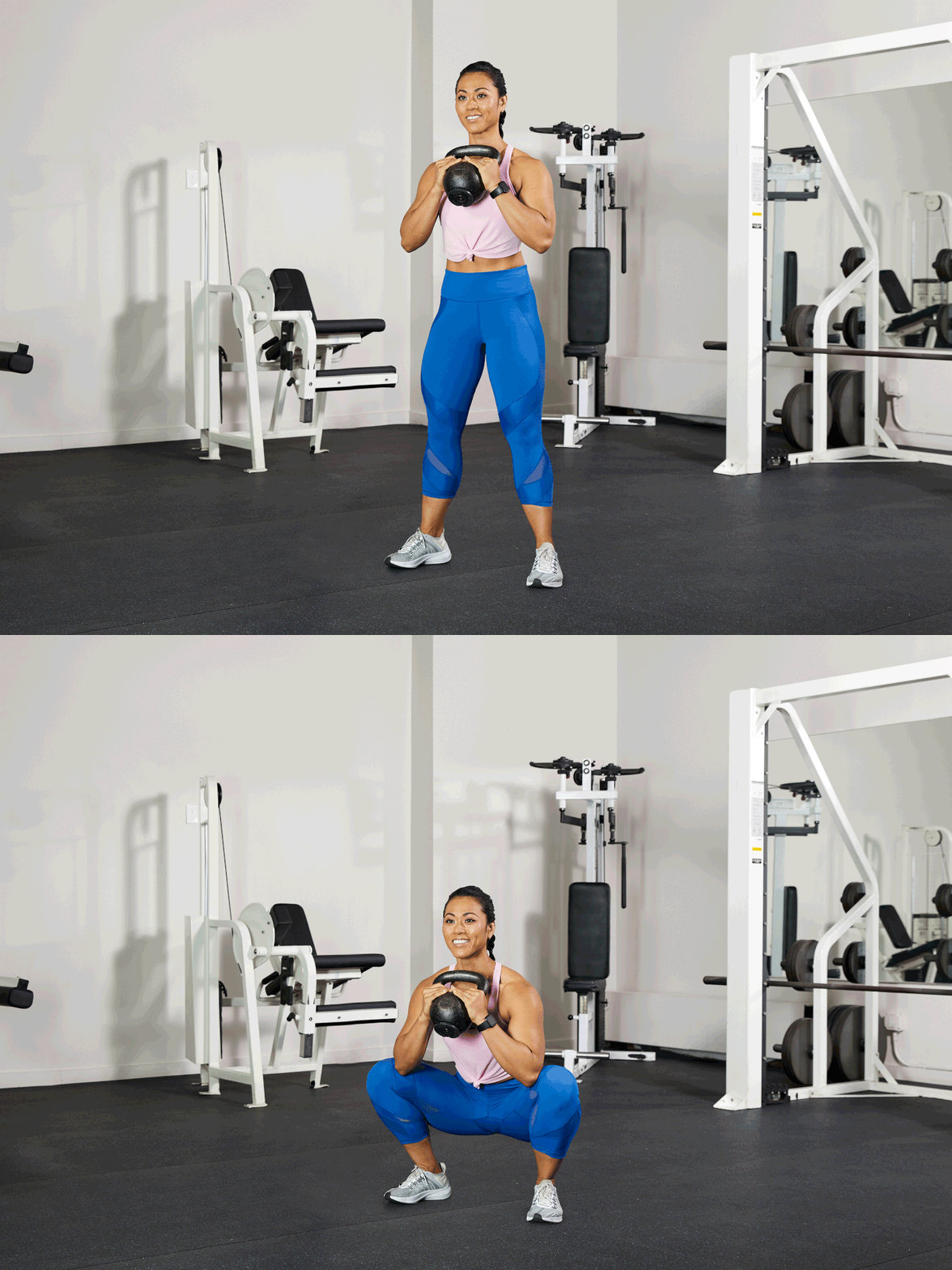
- Goblet Squats: I hold a single weight with two hands (a dumbbell, kettlebell, or even a water jug) vertically against my chest and squat down low to the ground. This front-loaded position naturally keeps the torso upright, shifting stress away from the lower back and onto the quads and glutes. This is my go-to variation, reducing pressure on the spine. I usually do 3 sets of 8-12 using a weight that leaves 2-3 reps in the tank (i.e. I'm not fighting for my life to complete that last rep, as that puts form at risk).
- Wall Sits: I press my back flat against a wall, slide down until my thighs are parallel to the floor with my knees at 90 degrees, and just hold it. This builds intense isometric tension in the quads without any joint movement or spinal pressure. I aim for 2 to 3 sets for as long as I can hold it. This exercise builds both physical and mental fortitude as you battle through the lactic acid burn.
- Deep Squat Rest (Asian Squat): I drop into a full, deep squat with my feet flat on the ground and my butt near my heels. If my ankles or hips are feeling tight, I hold onto a door frame or a sturdy post for support. I accumulate 2 to 3 minutes of this daily to restore primitive ankle and hip mobility, which instantly relieves tension in the lower back. I often do this throughout the day, such as when I'm playing with my dog or gardening.
- Floor-to-Feet Transitions: I lie or sit completely down on the floor, then get back up to a standing position using as little external support as possible. I vary how I do it every time, using my hands, moving to my knees, or rising up cross-legged. This keeps my core strong and preserves the basic, vital ability to get up after a stumble. Again, I do this throughout the day accumulating 10-20 repetitions over time.
- Single-Leg Balance Stand: I stand on one foot with my eyes open, focusing on stabilizing through my foot, ankle, and hip. To make it harder, I close my eyes or stand on uneven ground like a garden bed or a soft cushion. This trains the proprioceptive system so I don’t roll an ankle on rough terrain. I do 3 sets for as long as possible.
For these and my other strength-building exercises, I strive for intensity where I am 100% focused on the work. There's no room for long conversations, doom scrolling, or casual people-watching. Instead, I focus on the movement, my form and breathing, and the muscles I'm meant to be working. The aim is to safely push the muscle so my body needs to adapt to the work over time.
As I mentioned, in addition to dedicated intense exercise time, I weave strength, mobility, and balance exercises seamlessly into my day. Importantly, I don't consider daily activity as "permission" to avoid dedicated exercise time. The difference being the level of intensity.
Here are a few habits to help make strength, mobility, and balance part of everything you do:
- Active Rest Positions: I ditch the couch when I'm relaxing at home. I sit directly on the floor while reading, watching things, or planning projects. Constantly shifting positions on the floor forces my core, hips, and legs to make minor adjustments, preventing the structural freezing that happens when you sit in standard chairs all day. I also often stand when working at the computer, although my knees ache if I go too long.
- Daily Chores: I turn basic garden maintenance into a mobility practice. When weeding, planting, or harvesting, I avoid bending straight over at the waist, which wrecks the lumbar spine. Instead, I drop into a full deep squat or use a lunging position. This turns homestead chores into a built-in mobility session.
- Rucking and Varied Terrain: When I go for walks, I intentionally seek out uneven ground, gravel paths, hills, and exposed roots instead of staying on flat, dead pavement. This forces the stabilizing muscles in my feet and ankles to work continuously. To add a strength stimulus, I wear a backpack loaded with 10 to 20 pounds of water or gear. This practice (aka "rucking") builds cardio capacity and structural leg strength at the same time. Start with short distances, easier terrain, and lighter weights.
- Footwear Minimization: Modern cushioned shoes act like casts for your feet, deadening nerves and weakening the intrinsic muscles of your arches. I spend plenty of time barefoot inside the house, and I switch to functional footwear when working outside. Strengthening your feet directly improves your balance and cuts down on knee and hip strain further up the chain.
Despite what many hope, physical exercise doesn't offset bad habits. I don't smoke and rarely drink. Zero pop, juice, iced tea, and other forms of self-sabotage.
Honestly, I didn't really look "in shape" until I started tracking my food intake. Calories, protein, iron, calcium, potassium, sodium...I'm always fine tuning. But the daily caloric cap is what ultimately made the difference. You can't out-run a bad diet, and an extra sandwich a day is all it takes to gain weight. Nutritional tracking ensures your body has the raw materials to repair itself. Managing your caloric cap keeps excess weight off your joints, while looking better becomes a functional byproduct of systemic health.
Your ability to work, lift, endure, and move without pain is an unalienable asset. It cannot be separated from you. Prioritizing your physical strength is the foundational layer of practical preparedness. Start today.
I hope you found this helpful. If you have any feedback please share in the comments. My aim is to create a safe space for the collapse-aware to learn, converse, and share.
You have all taught me so much over the past couple years. This site is fueled by your energy. No corporate advertisers or secret sponsors. Just you, me, and my keyboard.
If you'd like to help, here are three things you can do:
- Share the articles
- Comment on the articles
- Support financially, as a paid subscriber or one-time contributor
Thank you.
Sarah