Global 10%: An inconvenient truth
The Western middle class has caused trillions in climate damages.
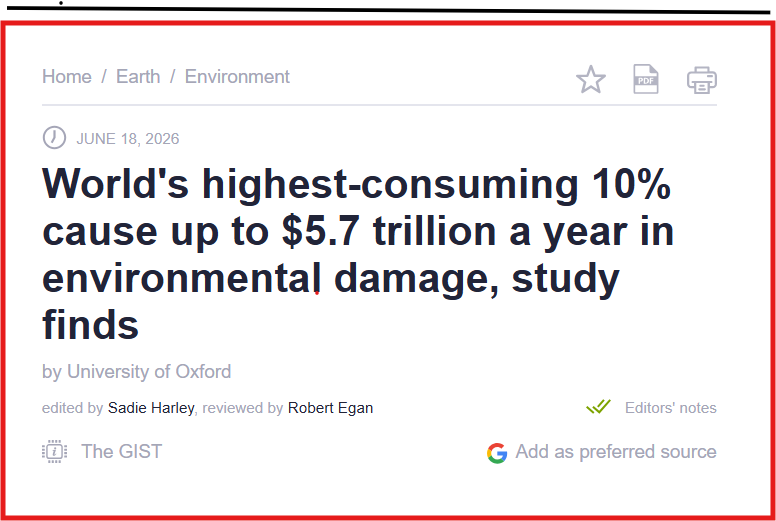
“The top 10% of global consumers is disproportionately responsible for transgressing planetary boundaries, causing damages for which broader society bears the costs.” - Environmental damages of the top ten percent consumers exceed global climate and biodiversity funding gaps, Nature, June 18, 2026.
When the phrase "global elite" or top 10% appears in print, the mind instinctively conjures a caricature. We picture private jets idling on the tarmac at Davos, oligarchs retreating to superyachts, and tech billionaires carving doomsday bunkers into the earth.
It is a comforting mental reflex. Blaming an untouchable class absolves the rest of us.
The reality of global income distribution tells a more inconvenient truth. If you are reading this article, with the assorted accoutrements of a middle class lifestyle, there is a good chance you are part of the top 10% of the global population. About 60% of the US and EU population is. And we owe a lot to the world for our daily conveniences.
Westerners often forget how we compare globally. Distracted by day-to-day economic realities, like affordability, the median income can feel precarious. However, on a global scale, that figure easily secures a seat within the wealthiest proportion (source: World Inequality Report).
The standard middle-class lifestyle in North America or Europe requires high-carbon consumption, constant energy use, and complex global supply chains. The emissions of the global top 10% arise heavily from domestic consumption and trade. For the wealthiest 1% and 0.1%, their massive transboundary contributions to local extremes arise primarily through investments and capital formation. We might not own the factories or even drive cars, but the economic system which sustains our lifestyles is a destructive monster.
According to the study, annual damages owed by the global 10% is $1.7–$5.7 trillion, equivalent to $2.3k–$7.5k per person (in $2017). The top 10% US consumers see a bill of $19k–$63k, equal to 6–20% of their income or 0.8–3% of their wealth. The two biggest contributors to the damage bill are biodiversity loss at 47–56% of the total and climate change at 36–45%. These costs highlight the mitigation responsibility of the global top 10%.
An earlier study published in Nature Climate Change by Sarah Schöngart and her colleagues measures the exact environmental damage the wealthiest demographic has inflicted upon the planet.
The researchers isolated the emissions generated by different wealth brackets and tied them directly to observed global temperature rises and extreme weather events. Using sophisticated climate models, the team ran "what-if" scenarios to see what the global climate would look like today if specific income groups had completely stopped emitting greenhouse gases after 1990. This approach allowed them to measure exactly how much warming and extreme weather was caused by these specific populations.
Findings: The data regarding the period from 1990 to 2020
- The wealthiest 10% of the global population caused roughly 65% of the total global mean temperature increase.
- The wealthiest 1% caused 20% of the warming.
- The top 10% contributed over seven times the global average to increases in 1-in-100-year heat extremes during peak summer months.
- The top 10% contributed six times the average to extreme meteorological droughts in the Amazon.
- Emissions from the top 10% in the United States and China led to a two- to threefold increase in severe heat events in highly vulnerable regions like the Amazon, Southeast Asia, and southeast Africa.
The researchers noted that if the entire world emitted at the rate of the bottom 50%, the planet would have experienced minimal additional warming since 1990.
Quantifying the link between wealth disparities and climate impacts forces a legal and societal reckoning regarding liability. There are historical precedents for similar damages. The exploitation of the Gilded Age catalyzed antitrust laws and conservation mandates to curb the concentrated power of industrial barons. The tobacco litigation of the 1990s provides a clearer parallel. Society treated the health impacts of smoking as individual consumer choices until researchers proved that tobacco companies obscured data and drove the public health crisis. Society then successfully sued for massive financial damages.
International climate law is laying the groundwork for a similar polluter-pays framework. Establishing precise liability for specific climate damages theoretically empowers lower-income nations to demand restitution. Of course, demanding and receiving are two distinct challenges, and liable countries are unlikely to accept responsibility, given the multi-trillion-dollar price tag. We’ve seen this in how the West points to China as the current chief source of emissions, completely disregarding accumulated contributions made by the West since the industrial revolution. Moreover, this liability shift distracts from the reality that much of China’s industrial output during the 21st century was produced for our, the global top 10%, individual consumption.
The right answer, 20 years ago, would have been for individuals like you and me living in Western nations to significantly reduce consumption, while simultaneously enforcing costs on the sources of emissions. Today, actions will form around mitigation, blame-shifting, and resource control.
Thank you for reading.
My name is Sarah and I run Collapse2050 by myself. It is a passion project to explore humanity's frightening future - a topic traditional media ignores.
The site is free for all, as I believe this information shouldn't be locked behind a paywall. I also don't accept corporate advertising so my articles remain unbiased.
Paid subscribers and one-time contributors to help me cover research and production costs.
Thank you.
Sarah