How the 2027 Super El Niño Will Replicate the 1877 Global Famine
Brutal El Nino, drought, war threatens food supply

In the spring of 2026, oceanographers began tracking a massive pulse of warm water moving eastward beneath the surface of the equatorial Pacific Ocean. This subsurface Kelvin wave, an ocean gravity wave that moves eastward along the equator and transports massive volumes of warm water, is now breaching the surface, signaling the rapid onset of a "super" El Niño. The World Meteorological Organization and NOAA have issued urgent warnings, predicting a 90 percent chance that this warming phase will persist through the winter of 2026–2027.
Today’s rapidly building El Niño shares parallels to the global climate anomaly of 1877–1878. That event, widely considered the strongest El Niño in recorded history, triggered multi-continent droughts and a subsequent global famine that claimed between 30 and 60 million lives (Davis, 2001), roughly 3 percent of the global population at the time.
But to understand the true danger of the emerging 2026/27 event, we must first correct a common historical misunderstanding. The El Niño of 1877 did not, on its own, cause the famines of 1877. The climate anomaly caused the droughts, the monsoonal failures, and the agricultural collapses. The famines themselves were entirely man-made. They were the direct result of imperial trade policies, laissez-faire economic dogma, and a political refusal to distribute food to those who could no longer afford it.
What occurred in 1877 was a catastrophic atmospheric convergence across three oceans. It began with an extraordinary preconditioning phase: between 1870 and 1876, the Pacific experienced a prolonged cold period, leading to a massive buildup of thermal energy in the western warm pool. When the pendulum swung, it discharged an El Niño of unprecedented magnitude, with sea surface temperatures in the central Pacific rising 3.5C (Huang et al., 2020) above average.
The Pacific warming did not act alone. In the Indian Ocean, sea surface temperatures developed a record-breaking positive Indian Ocean Dipole, an ocean-atmosphere phenomenon often called the "Indian Niño" that dramatically alters trade winds and precipitation patterns across the basin. This thermal gradient, characterized by warm waters off East Africa and extreme cooling near Sumatra, shut down the summer monsoons, plunging South Asia, Southeast Asia, and Australia into severe drought. At the same time, the North Atlantic Ocean warmed to its highest recorded levels since the 1850s. This shifted equatorial winds northward, starving northeastern Brazil of its seasonal rains.
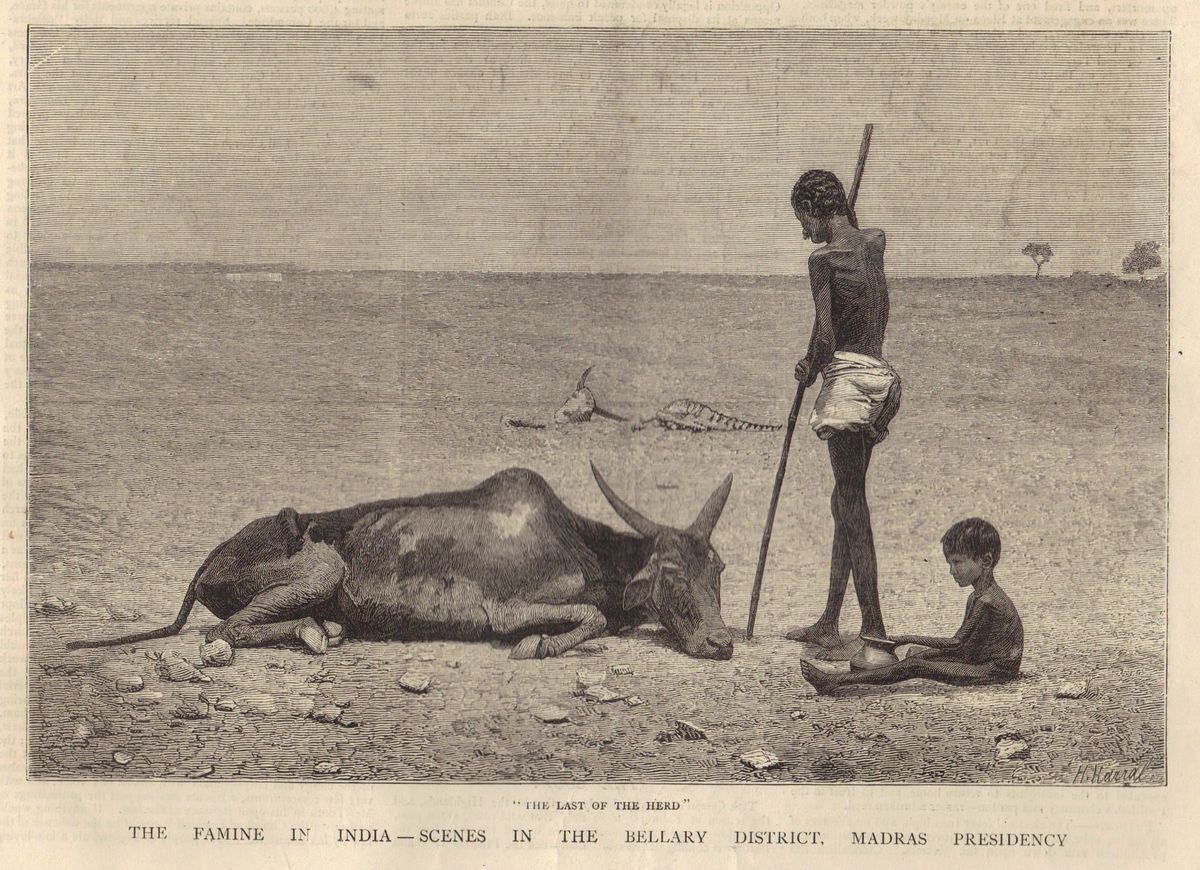
The agricultural collapse was swift and global. In British India, the monsoons failed completely across the Deccan Plateau, Bombay, Mysore, and Madras Presidencies. In Northern China, the crisis began as a regional dry spell during the preceding multi-year La Niña phase; winter crops failed in 1875, and when the climate pendulum swung, consecutive years of El Niño-driven drought turned five provinces into an arid dust bowl. Families tore down houses for fuel, sold children into slavery, and resorted to eating bark, clay, and carrion. In northeastern Brazil’s semi-arid sertão, the vast, scrubby backlands of the interior, the Grande Seca (Great Drought) decimated herds and dried up subsistence crops, leaving nearly a million sharecroppers starving.
While the droughts were environmental, the distribution of food was political. In British India, Viceroy Lord Lytton administered the crisis through a fanatical commitment to free-market capitalism and Malthusian population theory, the belief that famine is a natural and necessary check on overpopulation. Lytton argued that Southern India was overpopulated and that government intervention in grain markets would "create a habit of dependence" and disrupt the natural economy.
Even as local grain prices surged entirely out of reach for starving peasants, the colonial administration refused to halt the export of food. At the peak of the famine in 1877, Lytton oversaw the export of a record 320,000 tons of Indian wheat to Great Britain (Davis, 2001) to maintain imperial trade balances. To Lytton, the market was self-regulating and sacred. In the Madras Presidency, Special Famine Commissioner Sir Richard Temple went so far as to criminalize private charity, making it illegal to distribute private food donations that might interfere with grain prices.
Instead of direct relief, the colonial state established heavy labor camps. To qualify for a food ration, starving peasants were forced to travel miles on foot to work on infrastructure projects, such as the Bangalore-Mysore railway line. Temple introduced a ration known as the "Temple Wage". This consisted of 450 grams of grain per day for a long day of manual labor in extreme heat. The Temple Wage provided roughly 1,627 calories a day, fewer than the starvation rations later provided to inmates at the Nazi concentration camp Buchenwald (Davis, 2001), and far below what was required to sustain hard labor. Weakened by work and severe malnutrition, millions succumbed to cholera and malaria epidemics that swept through the unhygienic camps.
In Qing Dynasty China, the failure was one of administrative exhaustion rather than ideological cruelty. Unlike the British Raj, the Qing court acknowledged its duty to feed the starving and allocated 10.7 million taels (a standard Chinese weight for silver currency) of relief silver to Shanxi Province (Edgerton-Tarpley, 2008). However, the state’s strategic grain reserve system had been depleted by twenty-five years of internal warfare, including the Taiping Rebellion, and tax revenues had been diverted to military modernization.
Furthermore, China lacked the rail infrastructure to move grain into its mountainous, landlocked interior. Relief shipments rotted or were looted on mountain passes long before reaching Shanxi, where some 5.5 million people ultimately died (Li, 2007).
In Brazil, the imperial government in Rio de Janeiro simply ignored the sertão. Coastal sugar plantations continued to export their crops throughout the drought. Sharecroppers, known as flagelados (the scourged ones), were forced to migrate hundreds of miles on foot to the coast. Desperate and displaced, nearly 120,000 of these migrants were co-opted by Amazonian rubber barons, who used them as cheap, debt-bound labor to fuel the country's first rubber boom (Davis, 2001).
Today, as the 2026/2027 El Niño intensifies, we live in a vastly different geopolitical and technological world. Global forecasting is highly advanced, and absolute agricultural production is larger than ever. Yet the structural risks of modern food distribution remain remarkably similar. Cruelty still underpins the foundation for many government policies, with many oligarchs insulating their own wealth at the expense of the vulnerable.
This vulnerability is compounded by a modern agricultural engine that is already buckling under severe geopolitical stress. The recent closure of the Strait of Hormuz has triggered a massive spike in global energy prices and created critical shortages of the fertilizers essential for sustaining high crop yields. These kinetic disruptions are straining the global food system, acting as a dangerous socioeconomic preconditioning phase just as the climate pendulum begins to swing.
Beneath these geopolitical fractures, the baseline thermodynamics of the planet have fundamentally changed. In 1876, the global average temperature was 13.8C. Today, it is 15.23C, a baseline warming of 1.43C driven by fossil fuel emissions. James Hansen recently predicted the current El Niño could push the average global temperature anomaly to 1.7C above the pre-industrial average, making 2027 the hottest year ever recorded.
This extreme heat will release unprecedented energy into the atmosphere, intensifying localized droughts and monsoonal failures. The agricultural impacts will be highly asymmetric. While heavier rainfall may boost soybean production in the Americas, severe droughts are projected to reduce corn, rice, and wheat yields across South and Southeast Asia, Australia, and Southern Africa.
When crop failures occur, modern states frequently resort to a contemporary form of resource hoarding and unilateral export restrictions. The recent actions of the Indian government offer a preview of this dynamic. Facing domestic food inflation and monsoon damage, India, which controls roughly 40 percent of the global rice market, enacted a series of bans and surcharges on rice exports (IFPRI, 2023).
The ban triggered immediate panic buying and caused global rice prices to spike by 15 to 25 percent. It also prompted copycat protectionism, with Myanmar enacting its own temporary export restrictions (IFPRI, 2023).
For net-importing countries in South Asia and Sub-Saharan Africa, these unilateral policies are catastrophic. They do not lower domestic prices in the exporting countries, but they drastically reduce global supply, pricing the poorest populations out of the market. It is a modern iteration of what starved Madras and Shanxi 150 years ago.
As the Pacific pendulum swings toward an extreme warm state, the most terrifying parallel to 1877 is civilization’s impending response. We are facing a climate shock that exceeds the thermal extremes of the Victorian era. Unlike 150 years ago, despite getting hit by climactic and kinetic warfare, resulting in shortages and higher input prices, modern global agriculture could potentially still produce enough calories to sustain humanity through severe multi-continent droughts. But if history is any guide, even if aggregate worldwide production remains sufficient, a combination of bureaucratic ineptitude and ideological cruelty will once again dictate who eats and who starves.
Thank you for reading.
The site is free for all, as I believe this information shouldn't be locked behind a paywall. I also don't accept corporate advertising so my articles remain unbiased.
Paid subscribers and one-time contributors to help me cover research and production costs.
Thank you.
Sarah