Taiwan, Nuclear War, and Global Economic Collapse
An end scenario

During their summit in Beijing in May 2026, Chinese President Xi Jinping posed a question to U.S. President Donald Trump: "Can China and the United States transcend the so-called 'Thucydides Trap'?" This 2,500-year-old concept warns that when a rising power threatens an established hegemon, catastrophic war often follows.
Today, the flashpoint for this trap is the Taiwan Strait. A conflict over Taiwan is not just a regional dispute. If deterrence fails, the world faces a $10 trillion economic collapse, the destruction of the global semiconductor supply chain, and the risk of a nuclear exchange.
The question most people have is "why does the U.S. care about Taiwan?" For that matter, why does China care?
Why Beijing Wants the Island
The People's Republic of China (PRC) has never governed Taiwan, yet the Chinese Communist Party (CCP) views its annexation as an existential imperative. Rooted in the unresolved twentieth century Chinese Civil War, Beijing sees a democratic Taiwan as the final, agonizing chapter of its "Century of Humiliation." For Xi Jinping, absorbing Taiwan is tied directly to his legacy-defining goal of National Rejuvenation by 2049. Failing to secure the island could destabilize the CCP's autocratic rule and Xi's political survival.
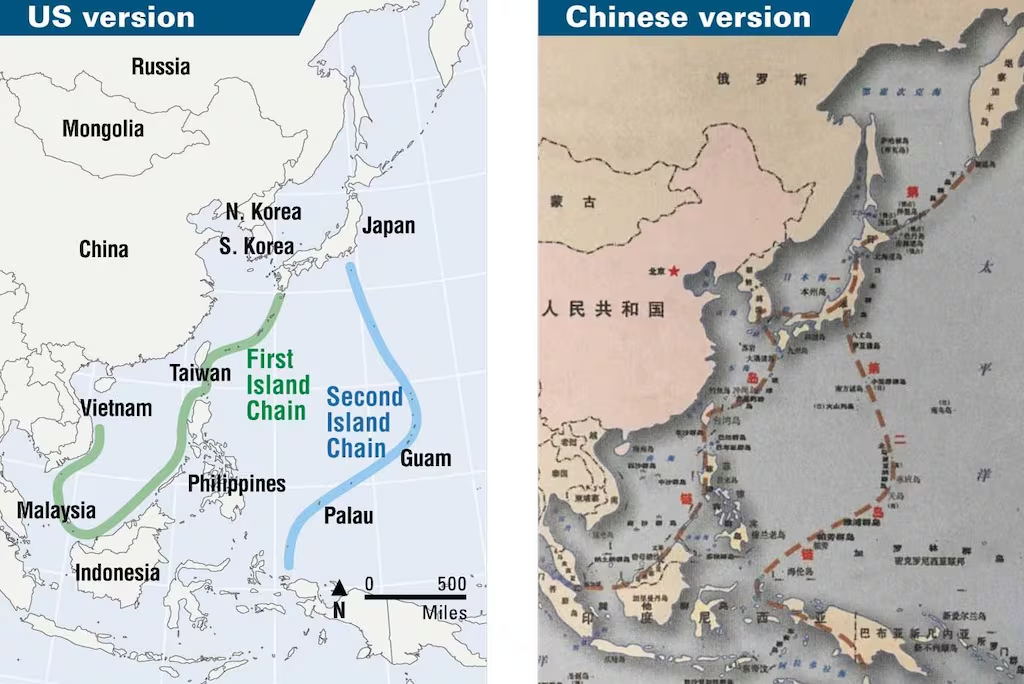
Geostrategically, Taiwan is the lynchpin of the First Island Chain, a network of archipelagos the U.S. uses to contain the Chinese navy. If Taiwan falls, Chinese nuclear-powered submarines gain unimpeded access to the deep Pacific, threatening Guam, Japan, and the Philippines, and effectively shattering American hegemony in the region. Control over Taiwan's eastern shore effectively decides China's fate as a counterbalance to America's reach in the Pacific.
The intelligence community heavily debates the timeline for a potential invasion, often focusing on the "Davidson Window." In 2021, Admiral Philip S. Davidson testified that the threat of a Chinese invasion would manifest by 2027. CIA Director William J. Burns later corroborated that Xi had instructed his military to be ready to invade by that year.
However, many China experts view 2027 as a military readiness milestone rather than a deadline for attack. A full-scale invasion remains a massive gamble; failure would likely end Xi and possibly the entire ruling party. Therefore, analysts assess China is more likely to use this window to build leverage, aiming to coerce or blockade Taiwan rather than immediately launching a kinetic assault.
Strangling vs. Storming
If coercion fails, the People's Liberation Army (PLA) has two primary military pathways: a blockade or an amphibious invasion.
A blockade uses coast guard and naval vessels to either prevent imports or slow their arrival via checkpoints and inspections. This keeps China's actions below the threshold of total war. This forces the U.S. into an impossible choice: break the blockade by firing the first shot, risking global war over customs inspections, or do nothing, effectively accepting Chinese control over Taiwan. This also forces Western companies shipping to Taiwan to abide by Chinese administrative rules, further recognizing the transfer of control.
Conversely, an amphibious invasion requires total military commitment. A 2026 wargame by the Center for Strategic and International Studies (CSIS) modeled this scenario, showing hostilities starting with a massive mainland missile barrage that destroys Taiwan's navy and air force. The wargame concludes the invasion would likely fail if Taiwanese ground forces contain the beachheads and U.S. forces, operating from Pacific islands, sink the Chinese amphibious fleet. However, this victory is pyrrhic. The U.S. would lose dozens of ships and many aircraft and thousands of servicemembers, while Taiwan's high-tech economy would be destroyed, creating massive damage to the global economy.
In either situation, Washington faces a binary choice: fight a direct war against a nuclear near-peer, or abandon Taiwan.
Defending Taiwan triggers a great-power war where staggering U.S. losses would permanently cripple American global standing. Conversely, abandoning Taiwan ends the U.S. security umbrella in the Pacific. Allies like Japan and South Korea would likely accommodate Beijing or develop their own nuclear weapons. Furthermore, China would absorb what's left of Taiwan's semiconductor manufacturing capacity, securing monopolistic control over the global technology.
The greatest risk in a U.S.-China hot war is rapid escalation into a strategic nuclear exchange. RAND Corporation analysts warn that nuclear escalation is highly plausible in this scenario, and no tactical planning can reduce this risk to zero.
To protect its Pacific fleet, the U.S. must bombard military nodes deep within the Chinese mainland. Because China's conventional and nuclear command-and-control systems are deeply entangled, Beijing can easily misinterpret conventional strikes as a preemptive decapitation attack. This ambiguity could force China into a "use it or lose it" posture, triggering a nuclear first strike. Additionally, if China uses cyber warfare to blind U.S. early-warning satellites to protect its fleet, the U.S. might interpret the blackout as a prelude to a nuclear strike, sparking rapid counter-escalation.
To deter American intervention, China has developed an asymmetric strategy targeting the U.S. homeland through "Volt Typhoon," a state-sponsored cyber group.
Volt Typhoon hides within native network tools and hijacked residential routers to avoid detection. The group has infiltrated American electric utilities, water systems, and maritime ports. Their objective is sabotage: disrupting U.S. military mobilization by cutting power to bases, and inciting domestic panic to shatter the American public's political will to fight.
The $10 Trillion Abyss
Bloomberg Economics estimates a war would cost the global economy $10 trillion in its first year, a 10.2% reduction in global GDP, eclipsing the 2008 financial crisis and the COVID-19 pandemic combined.
The primary economic trigger is the severing of the semiconductor supply chain. Taiwan, mostly Taiwan Semiconductor (TSMC), produces roughly 90% of the world's advanced semiconductors. Taipei has banked on this dependency to deter attacks and guarantee Western protection. In a conflict, these delicate fabrication plants would be destroyed or sabotaged. Taking TSMC offline would freeze global production of smartphones, AI data centers, EVs, and advanced military weapons. Rebuilding this capacity elsewhere is a multi-decade endeavor requiring hundreds of billions of dollars, as a single fab costs upwards of $30 billion and relies on a highly specialized global ecosystem.
If the West relies on economic sanctions rather than military force, the collateral damage will still be immense. Sanctioning China's banking sector to cut it out of the global dollar payments infrastructure would instantly put $3 trillion in global trade flows at risk. Moreover, China would likely firesale US assets putting upward pressure on US bond yields, debt which helps underwrites US power and living standards.
Furthermore, China controls the global supply of critical minerals, processing 90% of the world's rare earth elements. Beijing has already utilized export restrictions as a warning. A total embargo would paralyze the Western defense industrial base, with alternative supply chains requiring at least 15 years to mature.
Without semiconductors, critical minerals, Chinese goods exports, and demand for US debt, the resulting economic depression would structurally degrade the Western standard of living and trigger crushing inflation.
Ironically, this devastating path could create an alternate, more balanced, future. Hegemonic power is split, industrial production capped, and technological rabidity tamed, forcing civilization down a peg or two. The connection to the polycrisis might not be obvious, but these are the end states of ambition. One way or another, natural consequences, whether war, famine, or disease, eventually put a lid on human civilization. This is but one scenario.
Thank you for reading.
My name is Sarah and I run Collapse2050 by myself. It is a passion project to explore humanity's frightening future - a topic traditional media ignores.
The site is free for all, as I believe this information shouldn't be locked behind a paywall. I also don't accept corporate advertising so my articles remain unbiased.
Paid subscribers and one-time contributors to help me cover research and production costs.
Thank you.
Sarah