Canada: This is your future
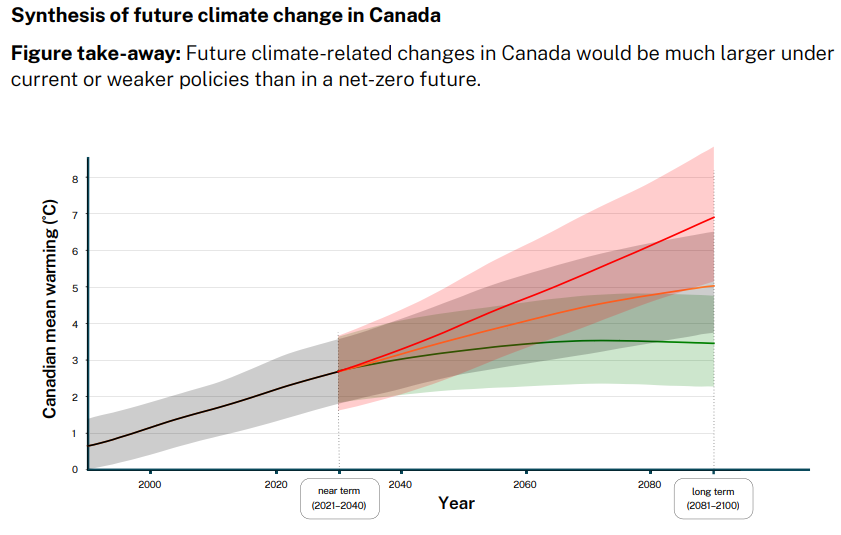
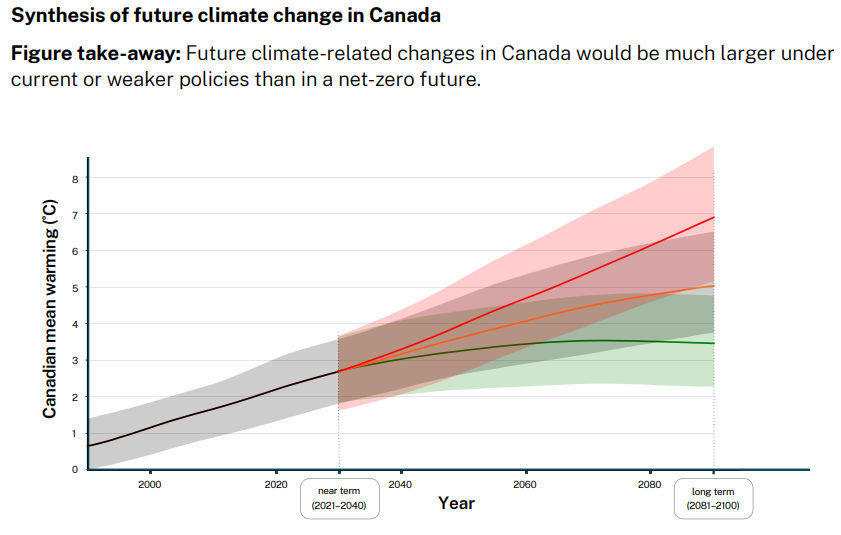
Long-term temperature increase in Canada of 5-7°C.
Earlier this month, the Canadian government released a report detailing the climate future for the country. It gained little media attention.
The findings are matter-of-fact and bleak.
While most studies examine broad global averages, this report shows illustrates the extreme variation by latitude.
The main takeaways:
- Northern climates are warming at least twice as fast as the rest of the world.
- If current policies persist (SSP2-4.5), Canada can expect to be 5°C warmer by the last quarter of this century.
- If policies deteriorate (SSP3-7.0), Canada will get almost 7°C warmer.
Here are the key realities from that report:
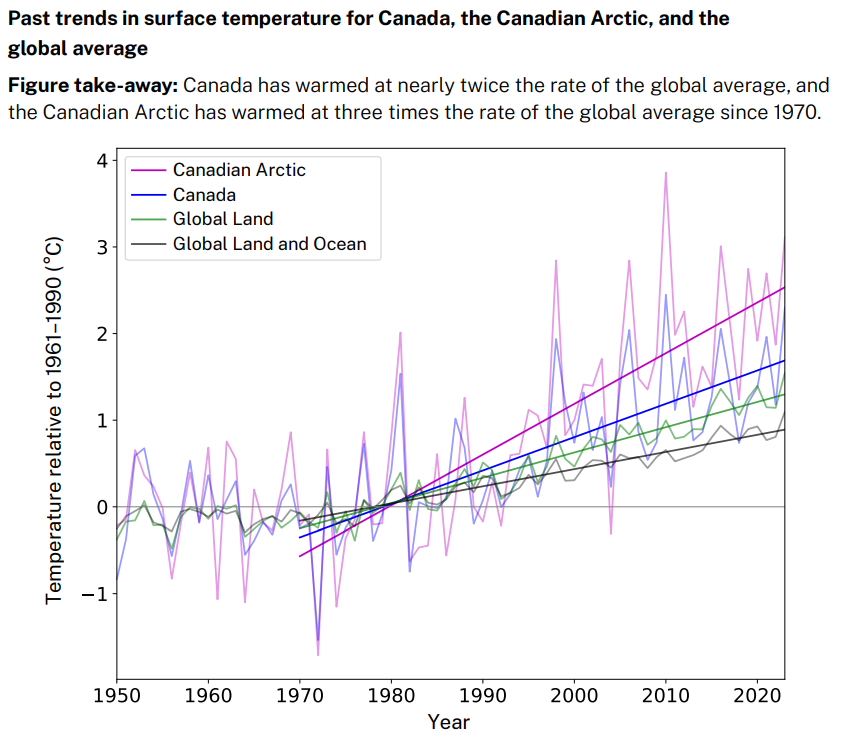
- Canada has warmed over the past 75 years due to emissions of greenhouse gases from human activities. Over this period Canada has warmed by 2.0°C and Canada’s North has warmed by 2.6°C.
- Canada has warmed rapidly over the past 50 years, consistent with rapid global warming. Since 1970, Canada has warmed nearly twice as fast as the global average, and the Canadian Arctic has warmed three times as fast as the global average.
- Annual total precipitation has increased in Canada over the past 75 years with the largest percentage increases in northern Canada. Annual total precipitation in Canada has increased much faster than for the global land area over this time frame.
- Warming temperatures have driven wide-ranging, interconnected, and sustained changes across Canada. The changes include more extreme heat, less extreme cold, longer growing seasons, longer fire seasons, earlier peak stream flow, shorter snow and ice cover seasons, thinning glaciers, thawing permafrost, warming oceans and rising sea level. Human-caused warming is the only explanation for the collective changes observed.
- In the near term, annual average temperature in Canada is expected to rise by about 1°C from 2021 to 2040. This unavoidable warming will exacerbate climate trends that are already observed.
- Whether warming in Canada intensifies or stabilizes in the second half of the century will be determined by the level of global greenhouse gas emissions. Warming in Canada will intensify as long as global greenhouse gas emissions continue. Temperature in Canada will stabilize only if and when global carbon dioxide emissions reach net zero.
Current global emissions policies imply a long-term temperature increase in Canada by 5°C.
- The warming and associated changes in climate in Canada are effectively irreversible. Some warming-driven changes, such as sea ice loss, will stabilize if temperature stabilizes. Sea-level change, glacier melt, and permafrost thaw will continue even after surface temperatures stabilize.
- Human-caused warming has already affected the frequency and intensity of extreme temperature events in Canada. Increases in hot extremes and human heat-stress, as well as decreases in cold extremes, have been observed. These changes will intensify with additional global warming.
- Droughts and flash floods will become more frequent and severe with additional warming. Summer droughts are projected to become longer, and more intense, and occur more frequently in central and southern Canada. Increases in the frequency and intensity of atmospheric rivers (in high emissions scenarios) and of extreme rainfall will lead to more frequent and intense flash flooding.
- More frequent and intense extreme fire weather is projected for most regions of Canada. Fire seasons are already longer and will lengthen further with additional global warming.
- Summer freshwater availability in southern Canada is threatened by changes in the water cycle. Many important water cycle processes are occurring earlier in spring, such as snowmelt, peak stream flow, and groundwater recharge, with risks to summer water availability. In some western Canada watersheds, declines in glacier contributions to summer streamflow have already been observed.
- Iconic landscapes are changing across Canada as snow and ice disappear. Glaciers in western Canada will largely disappear by the end of this century. Warming temperatures have shortened the snow cover season and reduced sea ice cover of all types. Permafrost thaw is transforming the land in many places across northern Canada. These changes will intensify with additional warming.
- Extreme high sea-level events will occur more often where local sea level is rising. Local sea level is projected to rise faster than the global average along parts of the Atlantic and western Arctic coastlines of Canada. In these areas, extreme high sea-level events will be exacerbated during periods of high storm surge and high tides.
- The oceans around Canada have warmed and acidified because of greenhouse gas emissions from human activity. Marine heatwaves have become more frequent and intense. The oceans will continue to warm, absorb carbon dioxide, and acidify as long as air temperature and carbon dioxide continue to rise.
- Canada’s land and oceans are currently a carbon sink, consistent with their behaviour over recent decades (medium confidence). Canada’s oceans are expected to continue to be a sink in the future. In contrast, whether Canada’s land remains a sink or becomes a carbon source is uncertain. Increases in carbon uptake from vegetation growth on land may be offset by carbon emissions from permafrost thaw, wildfires, and other disturbances.
Full Government of Canada report:
10 Premises Behind Collapse 2050
What does “collapse” mean? What will the downfall of civilization look like? What am I suggesting people do? What if I’m wrong?
 Sarah Connor
Collapse 2050 is a reader-supported publication. No ads, no corporate ties, no lobbyists. To receive new posts and support my work, become a paid subscriber or make a one-time contribution.
Thanks
Sarah