Cannibalism and Murder: Do we Become Savages?
How do we behave when food, water, and resources disappear


Ultimately, it’ll be a lack of food that ends civilization. There are many ways we get there - nuclear winter, drought, fossil fuels depletion - but that’s not the point of this article. Rather, I want to know what I become when I am starving. I want to know what my neighbors become.
In the past, many believed humans were innately savages, and when the veneer of safety and comfort was eroded the remaining beast was permitted to appear. Once this occurs, survival needs replace moral rationality, steering the average person to murder and cannibalism.
Others believe humans are innately good, confounding morality with instinct. How can this be true when we seem to be governed by evil and selfish people? Perhaps the average person is “good” only because of where they fit in the social order. Given the right circumstances, do we all end up murdering each other for the last morsel of food?
To learn about the savage within, I looked at history starting with the Minnesota Starvation Experiment. Conducted during WWII, this research selected healthy men and put them through a semi-starvation period. Participants lost 25% of their body weight.
The subjects grew increasingly isolated, apathetic, and irritable, becoming obsessed by food. They experienced emotional blunting, cognitive dissonance, depression, and pessimism. Interpersonal relationships broke down.
They guarded their resources, licked their plates clean, and became aggressive. Some violently turned on themselves.
The key finding was that savagery wasn’t a consistent outcome of starvation. Instead, apathy, social disconnection, and obsession were the common denominator.
The Siege of Leningrad
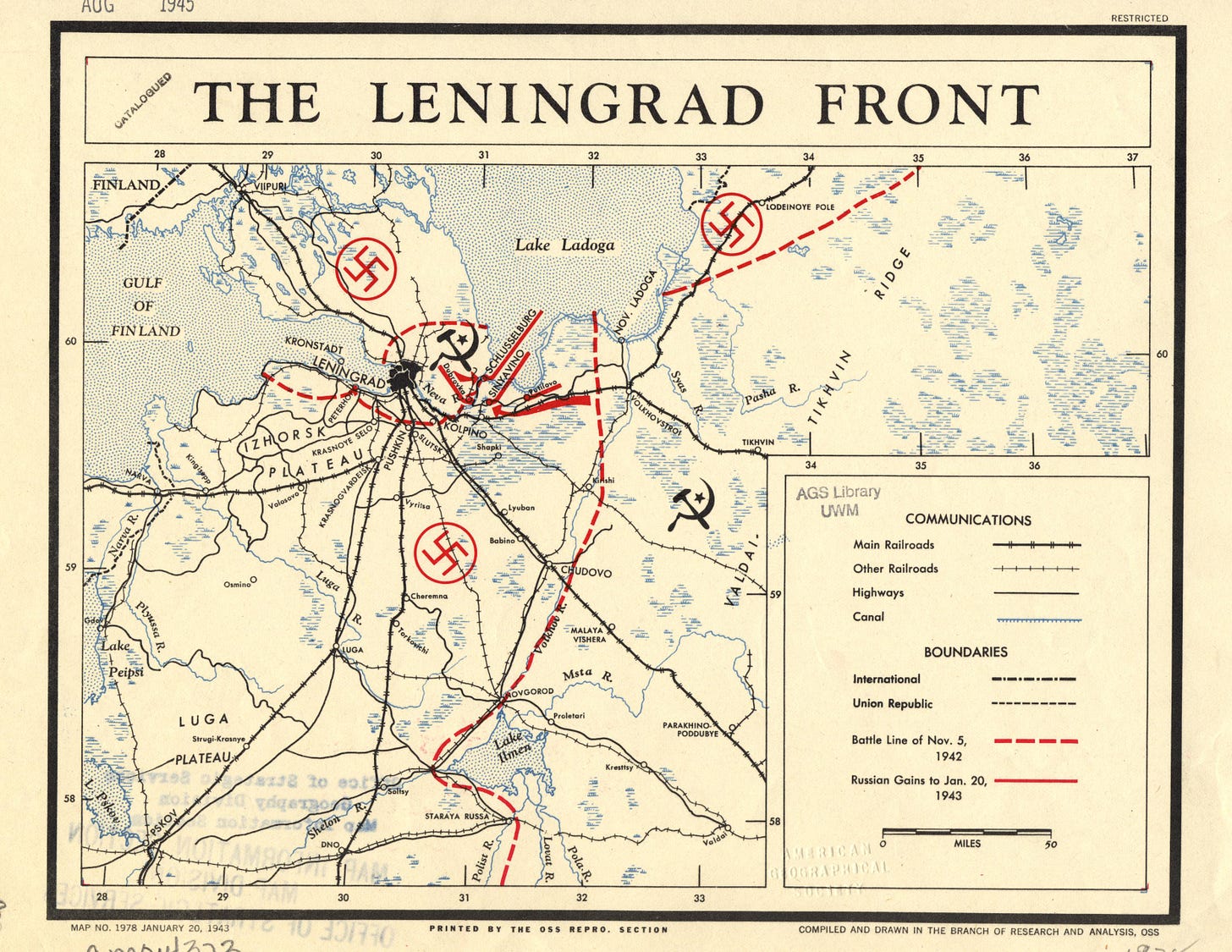
During WWII, Germany blockaded Leningrad for 872 days. Approximately one million citizens died from exposure, starvation, or disease.
As with the Minnesota Starvation Experiment, the common response was apathy and social atrophy. Both psychologically and physically. In a desperate attempt to survive, the body consumed itself, as autopsies showed organs shrank, including livers by 2/3 and hearts by 1/3.
Lidiya Ginzburg, a survivor, literary critic, and author of the Blockade Diary, observed that starvation caused an “alienation of the body,” where the conscious splits from the physical form, viewing the body merely as a manifestation of a hostile outside world.
As food = energy, starvation leads to a state of chronic exhaustion, explaining why most victims react passively becoming inured to death. Without the drive for self-preservation, murder and cannibalism disappear from the range of options. Instead, with the breakdown of social norms and lack of individual energy, the response to a neighbor’s suffering was distance:
“Every day she sees heavily swaddled figures swaying along the narrow footpaths. She can recognize the goners from their shuffling gait, and every day she worries whether to follow them or pass them by. The moment that they fall is the worst. They crumple and drop. She wants to stop—it’s the humane thing to do—but she has no strength to help them. So she tries to make her way past them, stepping around them, not over them, and never looking at the pile of cloth itself, lest an arm reach up or a pair of eyes implore.”
During the Siege of Leningrad, people lay in bed next to the corpses of their family members, too weak to move them, and sometimes deliberately kept the bodies in the apartment simply to use the deceased’s ration cards to prolong their own lives. The psychological blunting was a defense mechanism to avoid breaking down completely.
Once a source of social cohesion, food became an isolating experience. Yet, despite the social breakdown, most citizens simply faded into the night rather than turn to violence.
The savage few
As with any form of disarray, there is a minority that do the unthinkable. Often opportunistic, paired with cognitive dissonance. Sometimes premeditated.
Hunger-induced madness can push ordinary people to acts of barbarism. During the Holodomor of 1932-1933, over 2,500 people were convicted of cannibalism.
Approximately 69% of the accused were women, mostly aged 17 to 50, and were predominantly widows, single mothers, or divorced individuals lacking a support system. The acts of cannibalism they committed were the human psyche collapsing under the weight of incomprehensible trauma.
Anna Ivanivna Storcheus’s husband and three children died of starvation before her eyes. Anna killed and ate her fourth and final child, a girl named Nadiia. Was Anna a victim or a murderer? Many historians acknowledge people like Anna were not inherently evil. Rather, a form of psychosis becomes the maladaptive coping mechanism for some experiencing complete psychological and social destruction.
The Algonquins referred to this experience as “Wendigo psychosis”, explaining paranoia, anxiety, hallucinations, and an impulse to consume human flesh during periods of starvation or social isolation.
What distinguishes the Siege of Leningrad from other similar experiences of extreme deprivation is Leningrad was a city with a set of social norms. When the setting is more isolated, and few are watching, are people more willing to break taboos?
Almost mythological, the story of the Donner Party is a classic example of what can happen to small groups, distant from broader social oversight.
The Donner Party was a group of American pioneers stranded by heavy snow in the Sierra Nevada mountains during the winter of 1846-1847. Patrick Breen, an Irish immigrant who survived with his wife and all seven of his children, kept a detailed diary, documenting the psychological collapse of the group.
Initially, the group attempted to maintain normalcy. They built makeshift shelters and slaughtered their remaining oxen and cattle, preserving the meat in the freezing weather. As the snow deepened and the food vanished, the typical signs of deprivation and isolation began to set in. Breen’s entries reflect a systematic breakdown of norms. The taboo against consuming companion animals fell first:
“Mr. Curtis remarked that in the oven was a piece of the dog, and we could have it. Raising the lid of the oven, we found the dog well baked, and having a fine savory smell. I cut out a rib, smelling and tasting, found it to be good, and handed the rib over to Mr. McCutchen, who, after smelling it some time, tasted it and pronounced it very good dog.”
As the weeks dragged on, the members of the party began to boil and eat the ox hides that previously served as their roofs and blankets. When the hides ran out and individuals began dying of starvation and hypothermia, the surviving members transitioned to survival cannibalism. Breen’s diary entries from February 1847 were blunt, highlighting his own decline:
February 26, 1847: “The Donnos told the California folks that they commence to eat the dead people 4 days ago, if they did not succeed that day or the next in finding their cattle then under ten or twelve feet of snow…”
This was a capitulation to reality. A survival mechanism, with some refusing to participate.
Similarly, in 1972 a group of Uruguayan rugby players were stranded in the Andes after their plane crashed. Their 72 days in an extreme environment led to pragmatic savagery.
Dr. Roberto Canessa, a 19-year-old medical student at the time who later became a pediatric cardiologist, framed the decision to consume the dead not as a descent into savagery, but as a rational necessity. In his memoir, I Had to Survive, Canessa notes the conflict the group faced when confronted with starvation:
“Our story became world famous because of how we survived: by eating those who had died. It was, by far, our most eccentric idea, one that was simultaneously simple and audacious, and perhaps inconceivable. Hunger demands, above all else, to be satisfied.”
They ate their friends, teammates, and family members. The desecration of the dead was unthinkable, so the decision was reframed and compartmentalized. “Harmonizers” within the group helped alleviate the psychological tension by reframing the consumption as something similar to the Holy Communion. A gift from the dead to the living. Indeed, many explicitly gave permission to others that they be consumed if they died first.
This is where a nuance must be presented, as explained by Canessa:
“Cannibalism is when you kill someone, so technically this is what is known as anthropophagy. I’ve had these discussions for 40 years. I don’t care. We had to eat dead bodies, and that’s it.”
Notably, they didn’t survive as individuals degrading to barbarism. Rather, they redefined a new shared moral framework based on their predicament, and it was social cohesion and teamwork that helped them survive.
The transition from pragmatism to murder
There’s clearly a difference between eating someone who has already died vs killing someone to consume, the latter being more of an exception. Still, there are documented cases of both reluctant and opportunistic cannibals trying to survive in isolated, harsh conditions.
Courts have ruled that the temporary “suspension” of civilization does not permit a temporary suspension of civility. In 1884, R v Dudley and Stephens (Britain) ruled definitively that necessity is never a defense for murder. The legal doctrine established in this case dictates that the sanctity of human life is absolute and cannot be quantified, traded, or sacrificed, no matter how extreme the survival imperative.
Shipwrecked and adrift in the Atlantic for weeks in a rowboat, Captain Thomas Dudley and mate Edwin Stephens made the decision to kill a cabin boy who appeared already close to death. Dudley and Stephens murdered the boy to drink his blood and eat his flesh.
Dudley recounted:
“I took out my knife—first offering a prayer to God to forgive us for what we were about to do and for the rash act, that our souls might be saved—and I said to the boy, ‘Richard, your time has come.’ The boy said, ‘What me, Sir?’ I said, ‘Yes, my boy.’”
Upon their rescue and return to England, the men made no secret of what they did, genuinely believing that the unspoken “law of the sea” and the dire necessity of their circumstances justified the murder. However, the British courts demonstrated that the law cannot be expected to bend to extraordinary circumstances.
Clearly, there’s a degree of proportionality to survival, and there’s a vast divide between murdering an almost dead person to live another week and building a system of violence and oppression to control resources. For some, distance from civilization provides the opportunity to grasp power and resources through cruelty.
In 1629, the Batavia, belonging to the Dutch East India Company, wrecked near Western Australia. What happened to the survivors shows how fast a small isolated society suffering from a shortage of food can be turned into a murderous autocracy.
Two hundred survivors landed on Beacon Island with under-merchant Jeronimus Cornelisz. Prior to the wreck, Cornelisz had plotted to steal the ship and its cargo of silver and sandstone blocks. His plot was exposed and he feared rescue would lead to his execution, so seized tyrannical control over the survivors. He planned to prevent rescue and cull the survivors to preserve food and water.
By creating a lethal “in-group” that did his bidding, Cornelisz slaughtered over half the survivors, seizing resources and diverting threats to his control.
“The strongest were killed at night, their throats cut. Others were taken out on rafts and drowned. The sick and lame were also targeted. Then people were murdered at random, with many forced to kill other survivors to save their own lives. Total obedience was a person’s only chance of survival. Cornelisz’s men raped any woman they chose.”
How was one man able to turn another group into savages?
As we’ve seen many times in history, given the right circumstances, a small group of ordinary people turned ruthless by a charismatic dictator can be used to murder, rape, extort the majority. This is important to recognize, as today we observe the world speed-walking to fascism while asking “why isn’t anyone doing anything?”
According to social psychologist James Waller, the normalization of savagery among ordinary people exploits those with a predisposition towards conformist ethnocentrism, as opposed to psychopathy as one might expect.
Similarly, Christopher Browning’s book “Ordinary Men: Reserve Police Battalion 101 and the Final Solution in Poland” found that the group of men who made up this battalion were not ideological fanatics. Rather, they were conformists. Despite receiving permission to opt out, the vast majority still resorted to savagery, executing innocent civilians en masse.
Browning’s explanation was simple:
“To break ranks and step out, to adopt overtly nonconformist behavior, was simply beyond most of the men. It was easier for them to shoot.”
To cope, the perpetrators rationalized their actions. Propaganda helped reframe their actions as “acts of justice”. Alcohol abuse helped them forget, while compartmentalization placed their victims outside the battalion’s circle of human obligation.
Humans are frighteningly good at creating out-groups to rationalize horrific abuses of other humans. During the Rwandan genocide, Hutu extremists killed about 800,000 Tutsis and moderate Hutus. They weren’t killing alien strangers, rather they were friends, neighbors, and even extended family.
State propaganda had reframed the mind to view Tutsis as “cockroaches” and their eradication as communal work. The readily available machete became the weapon of choice.
“The club is more crushing, but the machete is more natural. The Rwandan is accustomed to the machete from childhood. Grab a machete—that is what we do every morning.”
The killing was systematic and pragmatic, aiming to eradicate entire bloodlines.
“Saving the babies, that was not practical. They were whacked against walls and trees or they were cut right away.”
Like in Poland, conformity to the group, the promise of material greed (plundering the victims’ property), and the absolution provided by state effectively removed the cognitive barrier that typically halts the decline into savagery.
This cognitive dissonance bleeds into the victim population, with a minority of the targeted effectively assisting the perpetrators. In “The Drowned and the Saved”, Primo Levi explained how Chaim Rumkowski, the Jewish elder of the Łódź Ghetto during WWII, wielded dictatorial power over his fellow Jews. He helped Nazis by organizing deportations to death camps, eventually, despite his assistance, becoming a victim himself.
Deprivation, power, and the suspension of morality sadly lead some to betray their peers. However, contradictory to what British courts found with R v Dudley and Stephens, it is difficult to comprehend from the comfort of modern civilized society.
Levi suggests:
“It is a judgment that we would like to entrust only to those who found themselves in similar circumstances and had the opportunity to test for themselves what it means to act in a state of coercion… The condition of the offended does not exclude culpability, which is often objectively serious, but I know of no human tribunal to which one could delegate the judgment.”
Given this, how does one separate victim collaboration from crimes against humanity committed by Nazis, who also argued that fear for their lives forced them to follow orders. The Nuremberg Trials exposed this excuse as unacceptable. Despite the extraordinary circumstances, and inability to fully comprehend the mindset of the Nazi soldier, the individual was not excused for their savagery.
 Sarah Connor
Morality of eating humans
Despite the plentiful supply of living and dead humans throughout historical famines, cannibalism is rare and universally taboo. Why do civic norms outweigh the survival imperative in many cases, despite the extreme circumstances? Why do some, no matter the cost, refuse to break the taboo?
Morality is often the social manifestation of evolutionary imperatives, either biological or social. Some part of our success as a species can be explained by our reluctance to see each other as a source of food.
Recent epidemiological models reveal that human cannibalism trades long-term survival costs for immediate sustenance. When humans eat humans, risks of prion diseases such as Kuru rise. This risk compounds with frequency. Cooking reduces the risk, but not entirely.
Also, hunting other humans provides a negative energy ROI. It is usually more calorically profitable to target unsuspecting flora or fauna. For this reason, most cases of cannibalism involve the already dead.
Finally, humans are a social species with evolutionary success highly connected to our ability to organize. Social cohesion across hundreds or thousands of people, most of which are relative strangers, requires trust. Trust in rules. Trust in aversion to violence. Trust you won’t become your neighbor’s next meal.
Combine these biological and social characteristics and it is clear the taboo against cannibalism isn’t arbitrary. Indeed, cannibalism is maladaptive and any populations that ate each other died off from disease or an inability to organize.
If human survival relies on the biological and social rejection of cannibalism, the true threat during civilizational collapse is not a neighborhood of bloodthirsty savages. The threat is the isolating apathy of starvation. We will likely not eat our neighbors. We will simply lack the calories to intervene when an opportunistic tyrant decides to exploit them.
I’d love to hear your thoughts on this subject. How will people change as infrastructure collapses, disasters overwhelm, and famine sets in?
Thank you for reading.
My name is Sarah and I run Collapse2050 by myself. It is a passion project to explore humanity’s frightening future - a topic traditional media ignores.
The site is free for all, as I believe this information shouldn’t be locked behind a paywall. I also don’t accept corporate advertising so I remain totally free to tear the kleptocracy a new one.
To fund these articles, I depend on the kindness of strangers. Paid subscribers and one-time contributors to help me cover research and production costs.
Thank you.
Sarah